What is the Hipot Test Voltage for 33kV Cable? A Complete VLF & DC Testing Guide?
Dealing with sudden cable failures after commissioning is a nightmare

Dealing with sudden cable failures after commissioning is a nightmare

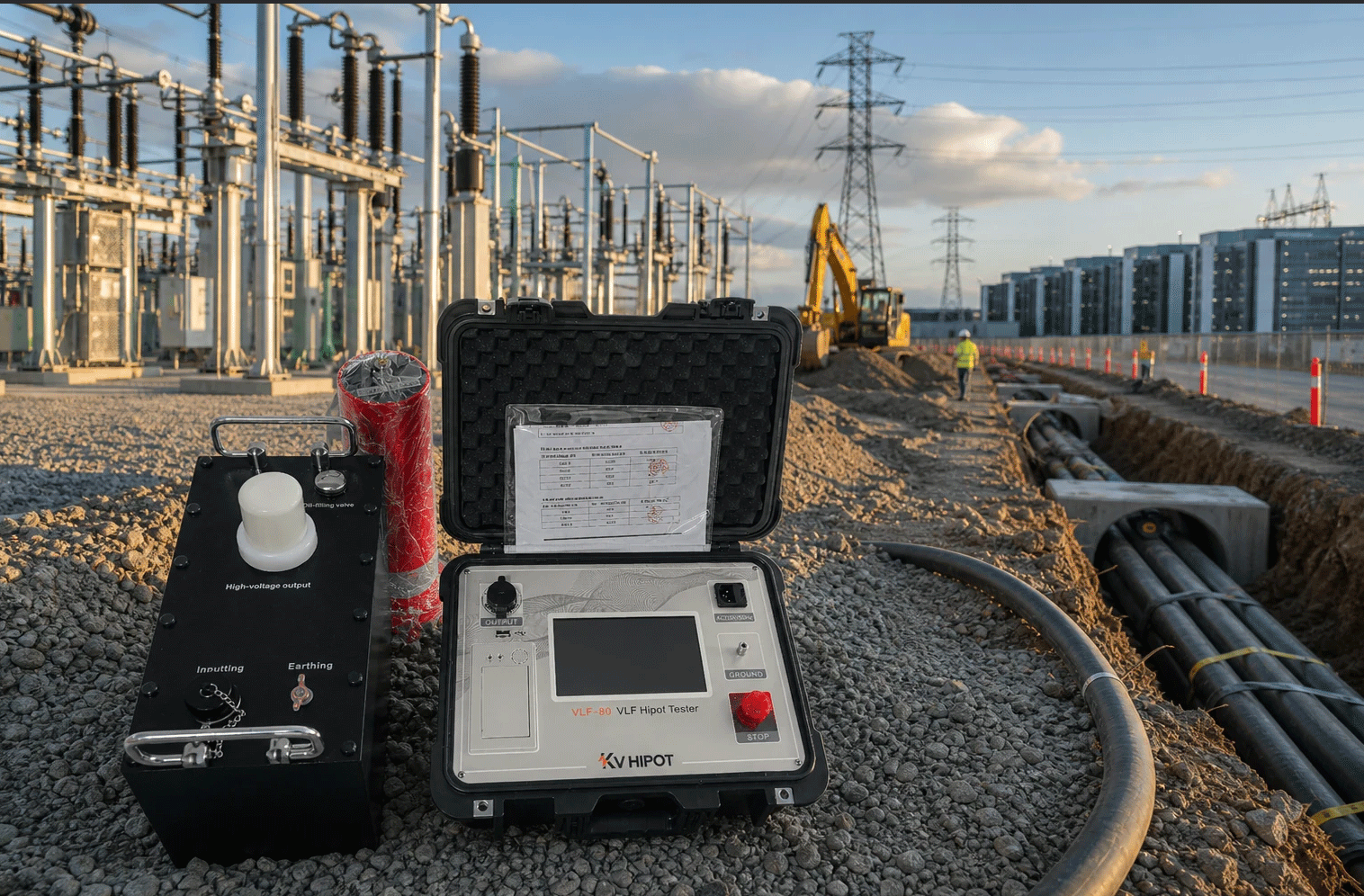
Utilities use planned VLF withstand or diagnostic work to support acceptance, maintenance prioritization, and investigation of shielded distribution circuits. Equipment selection and interpretation must also account for cable voltage, capacitance, waveform, condition, and the approved procedure.

A battery discharge tester is an electronic load device used to measure the true capacity of backup batteries. It pulls a constant current from the battery until a cutoff voltage. This test finds dead cells and proves the battery can support your critical systems during a real power outage.

This article explains the measurement principle, GST/UST/GSTg connections, field-testing procedures, abnormal-result troubleshooting and practical solutions for different transformer-testing environments.

You test transformer bushings to find deadly moisture and stop explosions. Use the right C1 and C2 connections, read the spikes correctly, and always replace failing parts immediately.

Maintaining high-voltage circuit breakers requires more than just mechanical checks; rigorous SF6 gas analysis is critical. A standardized maintenance checklist focusing on dew point testing, leak detection, and purity analysis ensures compliance with IEC 60480 standards.

Effectively managing SF6 moisture is non-negotiable for the safety and longevity of gas-insulated switchgear. An SF6 dew point meter serves as a critical early warning system, accurately measuring trace moisture to prevent the formation of highly toxic acids during arcing.

Performing an AC resonance test on XLPE cables requires careful planning and strict execution. The success of your high-voltage testing depends entirely on a correct setup and precise tuning.

SFRA is an indispensable diagnostic tool for the modern power industry. By treating the transformer’s internal structure as a complex RLC network, it provides a highly accurate, non-intrusive “fingerprint” of the mechanical geometry.

Le respect des normes internationales et la tenue de registres de contrôle précis garantissent le fonctionnement sûr de vos équipements électriques pendant plusieurs décennies.