

The fundamental operating principle of transformers is rooted in the law of electromagnetic induction. Their turns ratio and current ratio strictly follow the basic relationship: “The voltage transformation ratio is directly proportional to the turns ratio and inversely proportional to the current ratio.” This can be expressed as:
U₁/U₂ = N₁/N₂ = I₂/I₁,
where U is voltage, N is the number of turns, I is current, and subscripts 1 and 2 refer to the high-voltage and low-voltage sides, respectively. This relationship assumes an ideal transformer (zero copper loss, zero core loss, and zero leakage flux). In real engineering applications, losses and leakage flux require small adjustments to the turns ratio, though the fundamental principle remains unchanged.
Determining the appropriate turns ratio and current ratio depends not only on the rated voltage but also on a comprehensive set of design considerations, including transformer capacity, insulation class, cooling method, load characteristics (e.g., inductive or capacitive loads), and grid voltage regulation requirements. The following sections provide an in-depth analysis of transformers at different voltage levels, focusing on key parameters, correction logic, and application scenarios.
I. Low-Voltage Distribution Transformers
(Typical Voltages: 0.4 kV/10 kV, 0.4 kV/11 kV)
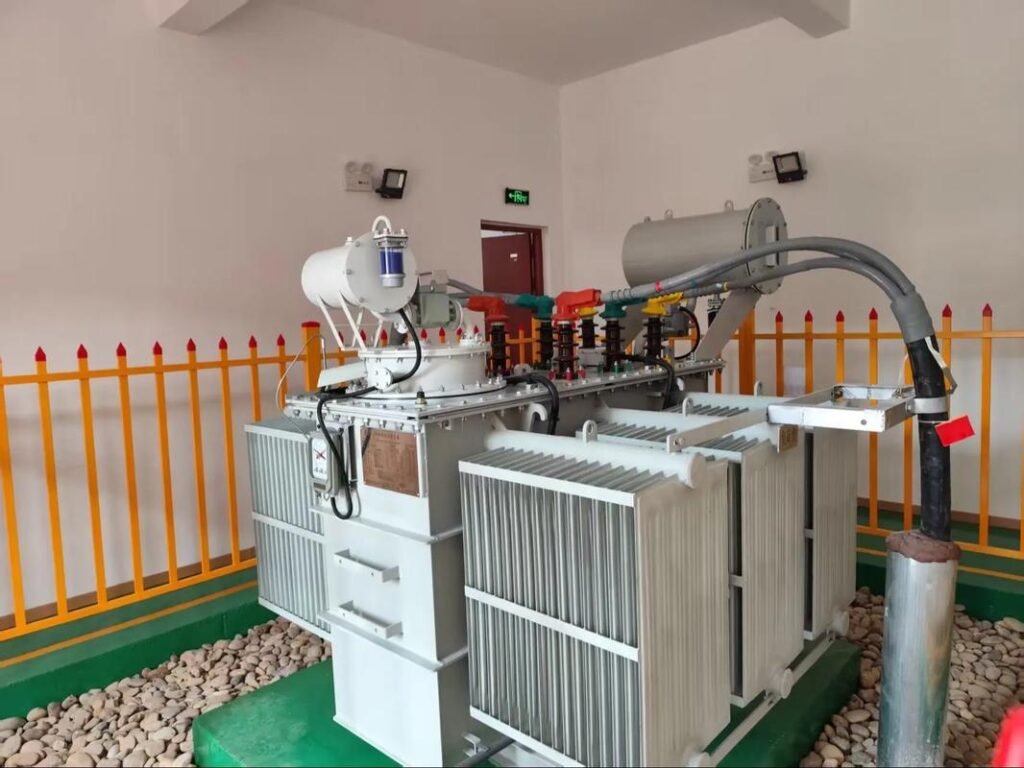
1. Core Parameters and Design Logic
These transformers serve as critical equipment at the distribution network’s endpoint, stepping high-voltage power down to low voltage for residential, commercial, and small industrial consumers. Their voltage levels comply with China’s low-voltage distribution standards (0.4 kV corresponds to three-phase four-wire systems, with a 380 V line voltage and 220 V phase voltage).
• Turns Ratio: The basic transformer turns ratio directly reflects the voltage ratio.
– For a 0.4 kV/10 kV transformer:
N₁/N₂ = 10 kV / 0.4 kV = 25 → 1:25
– For a 0.4 kV/11 kV transformer:
N₁/N₂ = 11 kV / 0.4 kV = 27.5 → 1:27.5
In practice, engineering designs often use adjusted ratios such as 1:10, 1:11, 1:12, 1:25, and 1:27.5 to compensate for voltage drops caused by load fluctuations. For example, during light-load conditions, fine adjustments to the turns ratio help maintain the low-voltage side within the required 380 V ± 5% range.
• Current Ratio: The current ratio is the inverse of the voltage (or turns) ratio.
For a 0.4 kV/10 kV transformer:
I₁/I₂ = 0.4/10 = 1/25 → 25:1 (low-voltage current is 25 times the high-voltage current)
Current values are more precisely derived from the transformer’s rated capacity. For instance, for a 1000 kVA 0.4 kV/10 kV transformer:
– High-voltage side:
I₁ = S / (√3 × U₁) = 1000 / (1.732 × 10) ≈ 57.7 A
– Low-voltage side:
I₂ = 1000 / (1.732 × 0.4) ≈ 1443 A
The resulting current ratio (1443 / 57.7 ≈ 25) closely matches theory, with small deviations caused by winding resistance and losses.
2. Application Scenarios and Compatibility Requirements
• Residential and Commercial Distribution: These areas experience fluctuating demand, with peaks typically in the morning and evening. Low-loss S11 or S13 series transformers are commonly used. Turns ratio design must support tap changer voltage regulation (typically ±5%) to prevent voltage sags during startup of inductive loads such as air conditioners and refrigerators.
• Small Factories and Workshops: Loads such as machine tools and pumps generate significant starting currents (3–7 times the rated current). Turns ratio selection must balance short-circuit impedance to avoid voltage distortion during startup. Current ratings must match low-voltage switchboard breaker ratings (e.g., 1600 A, 2000 A).
• Street Lighting Systems: These typically use single-phase or small three-phase transformers. Turns ratios like 1:10 or 1:11 are commonly used for 10 kV or 11 kV networks. Current ratios must accommodate low lighting loads, while winding configurations should minimize no-load losses—especially important because lighting transformers operate continuously at night, making no-load losses a key factor in operating costs.
II. Medium-Voltage Distribution Transformers
(Typical Voltages: 6 kV/35 kV, 6 kV/66 kV)
1. Core Parameters and Design Logic
Medium-voltage distribution transformers perform “mid-voltage conversion” within regional distribution networks, forming an essential link between high-voltage transmission systems and low-voltage user-side distribution. Their load capacity falls between that of low-voltage and high-voltage transformers, and they are commonly deployed in industrial parks, transportation hubs, and core urban distribution networks.
• Turns Ratio: The theoretical turns ratio for a 6 kV/35 kV transformer is:
35 / 6 ≈ 5.83 → 1:5.83
For a 6 kV/66 kV transformer:
66 / 6 = 11 → 1:11
Because medium-voltage networks typically experience relatively large voltage fluctuations (±10%), these transformers are often equipped with on-load tap changers (OLTCs). Tap changers enable real-time adjustment of the turns ratio under load to stabilize the 6 kV output. Typical tap positions on the 35 kV side may include 36.75 kV, 35 kV, and 33.25 kV.
• Current Ratio: The current ratio is the inverse of the voltage (or turns) ratio.
For a 6 kV/35 kV transformer, the current ratio is approximately 5.83:1 (low-voltage current is 5.83 times the high-voltage current).
For example, in a 5000 kVA unit:
– High-voltage side current:
I₁ = 5000 / (1.732 × 35) ≈ 82.5 A
– Low-voltage side current:
I₂ = 5000 / (1.732 × 6) ≈ 481 A
The actual current ratio (481 / 82.5 ≈ 5.83) aligns closely with the theoretical value.
Since medium-voltage transformers operate at higher electric field stresses, their winding structures employ layered construction with stricter turn-count tolerances (typically within ±0.5%). Deviations beyond this range can cause localized electric field concentration, increasing the risk of insulation breakdown.
2. Application Scenarios and Compatibility Requirements
• Industrial Parks and Large Commercial Complexes: Medium-voltage transformers are well suited for concentrated loads in midsize factories (e.g., machining, food processing) and commercial centers. Typical capacities range from 2000 kVA to 10,000 kVA.
Turns ratio design must consider load continuity to avoid excessive tap adjustments that could disrupt industrial processes. Current ratios must match medium-voltage breaker ratings (e.g., 125 A, 200 A).
• Medium-Voltage Distribution Network Interconnection: As key “network nodes,” these transformers step down 35 kV or 66 kV to 6 kV before further distribution. The turns ratio must align with regional grid voltage regulation strategies—especially upstream substation tap settings—to maintain system-wide voltage compliance.
• Transportation Infrastructure Power Supply: Used for trolleybus systems, metro traction power, and similar applications characterized by rapidly fluctuating inductive loads that generate harmonics.
Transformers require shielded windings to mitigate harmonic impact, and their current ratios must provide a safety margin of 1.2–1.5 times the rated load to handle peak traction-start currents.
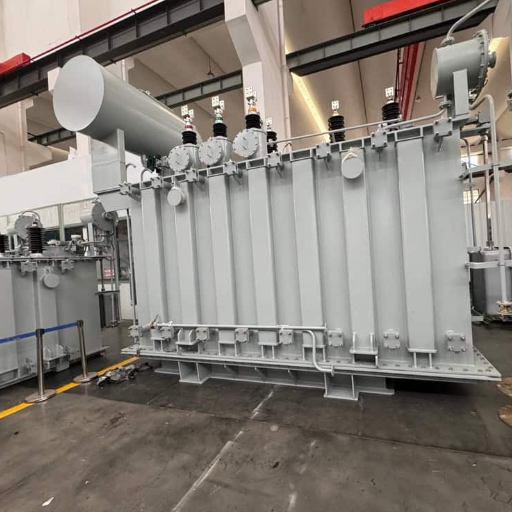
III. High-Voltage Transformers
(Typical Voltages: 110 kV/10 kV, 220 kV/10 kV)
1. Core Parameters and Design Logic
High-voltage transformers serve as major step-down units within regional power grids, converting high-voltage transmission power to medium-voltage levels inside substations. They receive electricity from power plants or transmission networks and distribute it to medium-voltage distribution systems. These transformers require high capacity, robust insulation systems, and excellent operational stability.
• Turns Ratio: The theoretical turns ratio for a 110 kV/10 kV transformer is:
110 / 10 = 11 → 11:1
For a 220 kV/10 kV transformer:
220 / 10 = 22 → 22:1
Due to the high voltage level on the high-voltage side and stringent insulation requirements, oil-impregnated paper insulation is used for the windings. The turns ratio design must balance insulation thickness with winding turn count. In addition, a no-load tap changer (typically ±2 × 2.5%) is installed to adjust voltage during planned outages and to compensate for long-term grid voltage deviations.
• Current Ratio: The current ratio is the inverse of the voltage (or turns) ratio.
For a 110 kV/10 kV transformer, the current ratio is approximately 1:11.
For example, for a 50,000 kVA (50 MVA) transformer:
– High-voltage side current:
I₁ = 50,000 / (1.732 × 110) ≈ 262 A
– Low-voltage side current:
I₂ = 50,000 / (1.732 × 10) ≈ 2,887 A
The actual current ratio (262 / 2,887 ≈ 1/11) is consistent with theory. Deviations mainly arise from no-load current (typically 0.5%–2% of rated current).
The current ratio must also coordinate with current transformer (CT) ratios to ensure accurate relay protection performance.
2. Application Scenarios and Compatibility Requirements
• Substation Integration: As core equipment in 110 kV and 220 kV substations, transformers must match upstream transmission line voltage levels (e.g., 220 kV/10 kV for 220 kV grid integration). Typical capacities range from 31.5 MVA to 120 MVA. Maintaining a stable turns ratio is critical to prevent voltage disturbances that could affect downstream distribution networks.
• Power Supply for Large Industrial Facilities: Industries such as steel, metallurgy, and petrochemicals require continuous heavy loads. Turns ratio design must consider load factors (often optimized for 80%–90% operation). Current ratios must align with high-voltage switchgear specifications to ensure short-circuit currents remain within equipment limits.
• Power Supply for Large Data Centers: Data centers demand extremely high reliability and often use dual-redundant transformer configurations. The turns ratio must coordinate with UPS and power conditioning systems to prevent voltage instability that could lead to server downtime. Current ratios should also include capacity margins for future expansion.
IV. Ultra-High Voltage (UHV) Transformers
(330 kV/220 kV, 500 kV/220 kV, 1000 kV/500 kV)
UHV transformers are used for long-distance, high-capacity power transmission and serve as key equipment in national grid backbone systems. They are divided into extra-high voltage (330 kV, 500 kV) and ultra-high voltage (1000 kV and above). Their design must balance transmission efficiency, loss reduction, insulation performance, and overall grid stability.
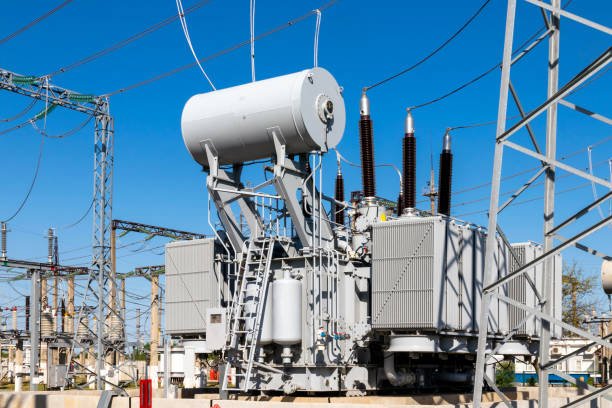
1. Extra-High Voltage Transformers (330 kV/220 kV, 500 kV/220 kV)
• Core Parameters:
For a 330 kV/220 kV transformer:
330 / 220 = 1.5 → 1.5:1
For a 500 kV/220 kV transformer:
500 / 220 ≈ 2.27 → 2.27:1
These units often function as “dual-purpose” step-up/step-down transformers in hub substations. Their turns ratio design must support on-load tap changing (typical regulation ±8 × 1.25%) to handle long-distance transmission voltage drops (5%–8% per 100 km).
Current ratios follow the inverse of the turns ratioThe current ratio of the 330kV/220kV transformer is 1:1.5 (the current on the 330kV side is 1/1.5 times that on the 220kV side).
Example (240 MVA transformer):
I₁ (330 kV side) = 240,000 / (1.732 × 330) ≈ 412 A
I₂ (220 kV side) = 240,000 / (1.732 × 220) ≈ 618 A
Ratio ≈ 1:1.5.
• Application Scenarios: These transformers are used for medium- and long-distance transmission (500–1000 km), such as transferring hydropower or thermal power from western regions to central load centers. Turns ratios must coordinate with transmission line impedance characteristics and regional dispatching strategies to optimize power flow and reduce losses.
2. Ultra-High Voltage Transformers (1000 kV/500 kV)
• Core Parameters: The theoretical turns ratio is:
1000 / 500 = 2 → 2:1
Current ratio: 1:2 (The current on the 1000kV side is half that on the 500kV side).
These transformers serve as core equipment in ultra-high voltage power grids, featuring extremely large capacities (typically 1000MVA and above). Their windings utilize ultra-high voltage insulation materials, with turn accuracy controlled within ±0.1%. They are equipped with dedicated voltage regulation and filtering devices to suppress electromagnetic interference and harmonics during ultra-high voltage operation.
Example (1000 MVA transformer):
I₁ (1000 kV side) = 1,000,000 / (1.732 × 1000) ≈ 577 A
I₂ (500 kV side) = 1,000,000 / (1.732 × 500) ≈ 1154 A
Ratio follows the theoretical 1:2.
• Application Scenarios: Used for ultra-long-distance (1000+ km) power transmission in national backbone networks—such as West-to-East and North-to-South power transfer. UHV transmission achieves loss levels roughly one-quarter those of 500 kV systems. These transformers also support cross-border power exchange by adapting to different national standards through precise turns-ratio management. They are essential for dispatching power from large nuclear and thermal plants into the UHV grid.
V. Key Factors Affecting Practical Design
The above turns ratios and current ratios represent theoretical values. Actual transformer design must adjust for the following factors:
1. Load Characteristics: Inductive loads (e.g., motors) require increased turns on the low-voltage side to compensate for voltage drops from low power factor. Capacitive loads require reduced turns to prevent overvoltage.
2. Loss Reduction: To reduce copper losses (related to winding resistance and current squared), designers may increase conductor cross-sectional area or reduce winding turns while maintaining insulation integrity.
3. Grid Voltage Regulation: Areas with significant voltage fluctuations require additional tap positions to expand turns-ratio adjustment capability and ensure compliant terminal voltage.
4. Insulation Class: Higher insulation levels on the high-voltage side lead to greater spacing between turns, causing small deviations in the theoretical turns ratio. Corrections must be applied through precise electromagnetic calculations.
VI. Conclusion
The turns ratio and current ratio of transformers across different voltage levels are fundamentally the result of comprehensive design based on the law of electromagnetic induction, taking into account voltage levels, rated capacity, application scenarios, and grid requirements. From the 1:25 turns ratio in low-voltage distribution networks to the 2:1 turns ratio in ultra-high-voltage grids, variations in the transformation ratio directly determine the distance, capacity, and efficiency of power transmission.
In practical applications, precise design of the turn ratio and optimization of the current ratio, coupled with measures such as voltage regulation devices, insulation design, and loss control, are essential to ensure stable transformer operation under varying load conditions. This provides core support for power supply across the entire industry chain.

 Tiếng Việt
  English
  العربية
  ไทย
ไทย  Italiano
  Español de México
  한국어
한국어  Português do Brasil
  Français
  Русский
  Español de Colombia
  Português
  Türkçe