

You need a new testing device for your next big power project. Choosing the wrong equipment wastes money and misses hidden faults. You must pick the perfect machine safely. To select the right tan delta tester for power transformers, you must check its voltage output, frequency range, and capacitance limits. The best tester offers anti-interference technology, easy portability for field use, and high accuracy to meet international testing standards for large grid assets. Selecting the best testing equipment feels confusing when many brands offer different features. Do not let complex data sheets stop you from making a smart choice for your business.
Why is a tan delta test mandatory during Factory Acceptance Testing (FAT) and SAT?
You worry about shipping damage when you buy a heavy transformer. A broken machine will ruin your project timeline. A mandatory test proves the equipment is safe to use. A tan delta test is mandatory during FAT and SAT because it proves the insulation quality before the machine turns on. It gives EPC contractors a legal baseline. This protects them from blame if the transformer fails later due to bad weather or grid problems. ! I work with many EPC contractors around the world. Risk control means everything to them. A factory makes a new transformer. The factory tests it. We call this Factory Acceptance Testing (FAT). Then, workers put the huge machine on a ship. The ship travels across the ocean. The machine faces moisture, physical shocks, and bad weather. Workers install the machine at the site. They must test it again. We call this Site Acceptance Testing (SAT).
Protecting Your Investment
The SAT results must match the FAT results. You have a huge problem if the numbers are different. Water probably entered the oil during the long trip. You use this data to force the factory or shipping company to pay for the damage.
| Test Stage | Location | Main Goal | Result Impact |
|---|---|---|---|
| FAT | Factory Floor | Prove build quality | Factory gets paid |
| Transport | Ocean or Road | Move safely | High risk of moisture |
| SAT | Project Site | Prove safe delivery | EPC avoids liability |
You protect your company from future legal trouble when you keep these test records. A good KVHIPOT tester gives you exact numbers to prove your case. You never have to guess about the internal health of the machine.
How does tan delta testing prevent premature failures in renewable energy projects?
Solar and wind farms run under harsh weather conditions. Sudden power stops cost you a lot of money. You must find weak parts before the whole system goes dark. Tan delta testing prevents premature failures in renewable energy projects by finding microscopic water inside the insulation early. Wind and solar transformers handle constantly changing electrical loads. This stress breaks down insulation fast. The test catches this damage before a complete grid failure happens.
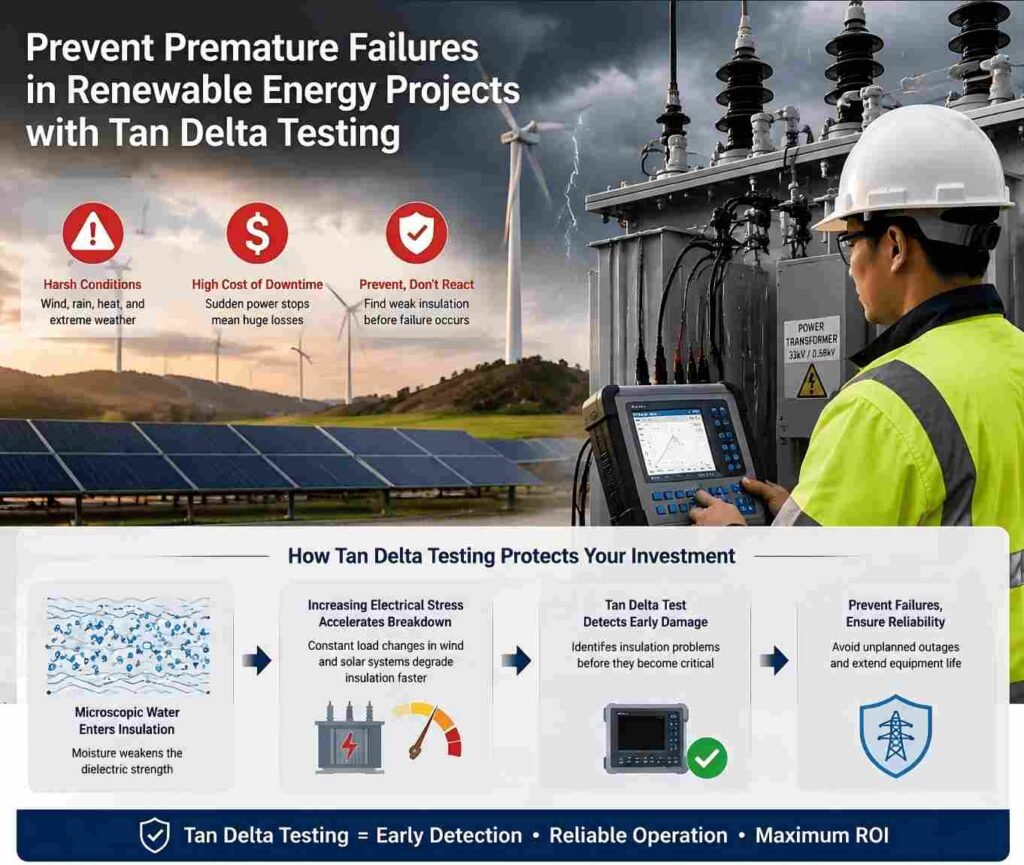
Renewable energy projects grow very fast today. I visit many solar farms in the Middle East and wind farms in Southeast Asia. These green power plants use special step-up transformers. These transformers face a very hard life. A normal city transformer gets steady power all day. A solar farm transformer gets full power at noon and zero power at night. This rapid heating and cooling cycle damages the paper insulation quickly.
Managing Thermal Stress
The hot sun and heavy rain also attack the outside of the machine. The rapid temperature changes pull moisture from the air into the oil. This moisture acts like poison to the electrical system.
| Transformer Type | Power Flow | Insulation Stress Level | Failure Risk |
|---|---|---|---|
| City Substation | Very Steady | Low to Medium | Normal |
| Wind Farm | Highly Variable | Very High | Severe |
| Solar Farm | Daily Cycles | High | Severe |
You must test these machines more often than normal city machines. The tan delta test tells you exactly how fast the paper is burning up. You can clean the oil during a planned stop. You stop unexpected explosions and keep the green energy flowing to the city.
What are the IEEE and IEC standards for transformer commissioning?
You submit your test report to the utility company. They reject your paper because it lacks standard proof. You must follow global rules to get your project approved. The IEEE and IEC standards for transformer commissioning set strict rules for insulation testing. IEC 60076 and IEEE C57.152 require specific tan delta values for new equipment. Following these global rules ensures the machine operates safely and passes all official government and utility inspections.
You cannot just guess if a machine is good or bad. You need a rulebook. The world uses two main rulebooks for high-voltage testing. North American countries mostly use the IEEE standards. European and Asian countries mostly use the IEC standards. I always ask my clients which standard their local power grid requires.
Meeting Global Requirements
These standards tell you the exact voltage to apply during the test. They tell you the exact temperature corrections to use. A test done at zero degrees looks different from a test done at forty degrees. The standards give you a math formula to fix this difference.
| Standard Name | Main Region | Focus Area | Required Action |
|---|---|---|---|
| IEC 60076 | Europe / Asia | Power Transformers | General test rules |
| IEEE C57.152 | Americas | Field Testing | strict pass limits |
| CIGRE Guides | Global | Best Practices | Maintenance advice |
Your new KVHIPOT testing device comes with these standard formulas built into its software. The machine does the math for you automatically. You print the report, and the utility company accepts it immediately. You finish the job faster and get paid on time.
How do third-party testing services utilize dissipation factor data to guarantee their work?
Your clients doubt the quality of your maintenance work. An angry client will not hire you again. You need solid data to prove your repair job worked perfectly. Third-party testing services utilize dissipation factor data to prove the equipment is completely safe after repairs. They show the client the high number before the oil cleaning. They show the very low number after the cleaning. This clear data builds deep trust and guarantees their service quality.
I talk with many third-party electrical testing companies. They do not own the transformers. They just fix them for large industrial plants or data centers. These service companies face a big challenge. They charge a lot of money to filter the transformer oil. The client cannot see the clean oil inside the dark metal tank. The client wants proof that the expensive service actually worked.
Proving Service Value
The service company uses the tan delta tester to provide this exact proof. It gives them a digital fingerprint of the machine’s health.
| Service Stage | Tan Delta Value | Client Perception |
|---|---|---|
| Before Service | 2.5% (Danger) | Worried about failure |
| During Service | Oil is filtering | Waiting for results |
| After Service | 0.4% (Perfect) | Happy and confident |
The testing company prints a final report with clear graphs. The client sees the number drop from the danger zone to the perfect zone. The testing company uses this document as a legal guarantee of their work. They win more service contracts because they provide clear, scientific facts instead of just empty promises.



 English
  ไทย
ไทย  Tiếng Việt
  العربية
  Русский
  Italiano
  Español
  한국어
한국어  Português do Brasil
  Français
  Español de México
  Português
  Türkçe
  Čeština
  Español de Argentina
  Slovenčina
  Dansk
Dansk  Polski
  Deutsch
  Ελληνικά
  O‘zbekcha
  Bahasa Indonesia
  Română