


Unchecked SF6 moisture causes catastrophic switchgear arc failures. Stop reacting to costly outages. Implement this ultimate maintenance checklist to standardize dew point testing and protect your high-voltage assets proactively.
The ultimate SF6 maintenance checklist includes regular dew point moisture testing, leak detection, purity analysis, and zero-emission gas handling. Following these standardized procedures ensures IEC 60480 compliance, transforms reactive repairs into predictive asset management, and significantly extends the operational lifespan of high-voltage circuit breakers and GIS.
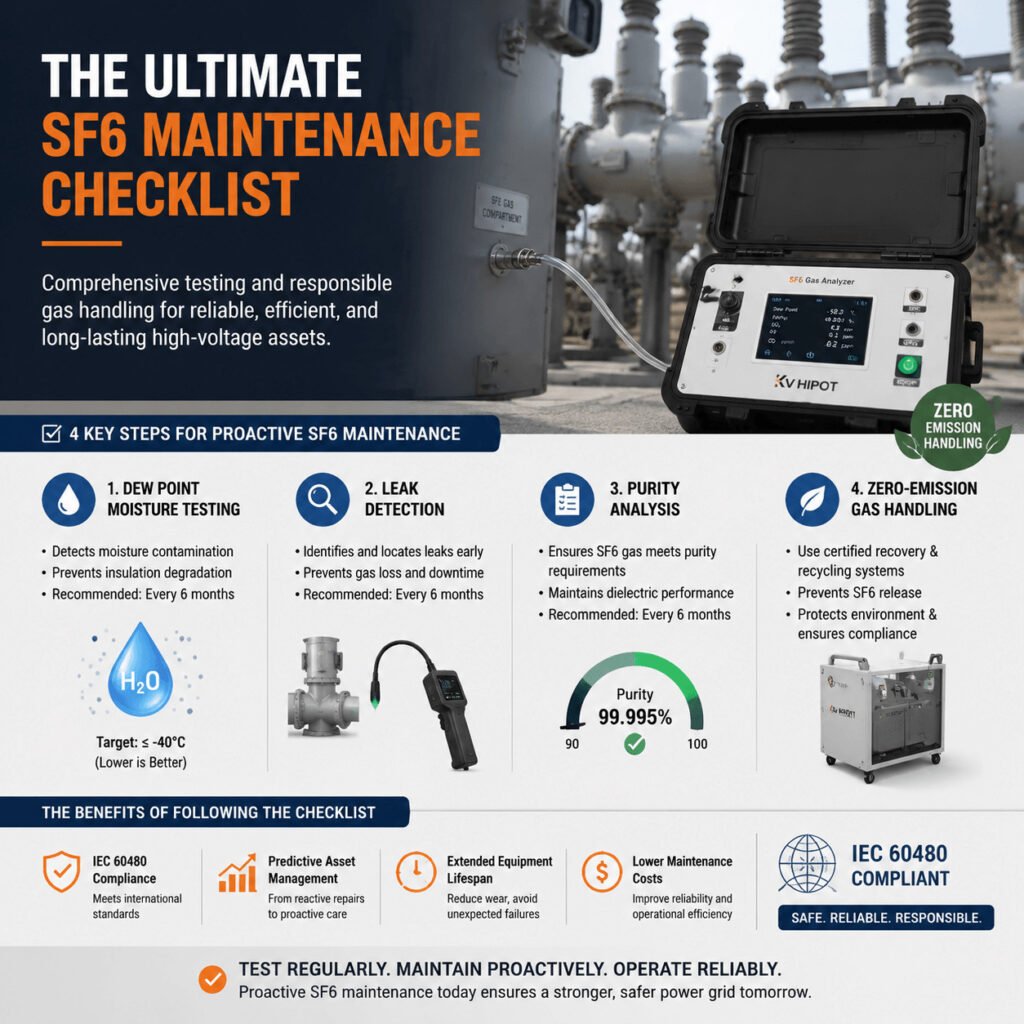
Developing a comprehensive testing routine isn’t just about ticking boxes on a clipboard; it’s about safeguarding critical power infrastructure. Let’s break down the essential steps and industry standards you must integrate into your predictive maintenance strategy so you can eliminate unexpected downtime forever.
What should be included in an HV circuit breaker maintenance checklist?
Incomplete inspections leave hidden faults undetected. When critical components degrade unnoticed, catastrophic equipment failure becomes inevitable. A comprehensive checklist eliminates guesswork, ensuring testing teams assess mechanical timing, contact resistance, and vital SF6 gas parameters to guarantee total system reliability.
A standard HV circuit breaker maintenance checklist must include mechanical operation tests (timing and travel), contact resistance measurement (loop resistance), and comprehensive SF6 gas analysis covering dew point (moisture), purity, and leak detection to ensure complete operational safety.
Shifting to Predictive Asset Management
Relying on reactive repairs is a dangerous game for power grids and industrial plants. A structured checklist transforms maintenance from reactive to predictive. By systematically recording baseline data, maintenance engineers can track degradation trends over time, allowing for planned outages rather than emergency panic.
Core Components of a Comprehensive Checklist
To ensure complete reliability, an HV circuit breaker inspection should be divided into mechanical and dielectric assessments. While mechanical tests verify the physical movement of the breaker, dielectric tests ensure the insulation medium—typically SF6—remains uncompromised.
| Maintenance Category | Key Testing Parameters | Recommended Equipment |
|---|---|---|
| Mechanical Testing | Opening/closing time, bounce time, travel curve | Circuit Breaker Analyzer |
| Electrical Testing | Loop resistance, dynamic contact resistance | Contact Resistance Tester |
| SF6 Gas Analysis | Dew point (moisture), gas purity, decomposition products | SF6 Comprehensive Tester |
| Leakage Detection | Sniffing for gas escaping from seals and flanges | SF6 Gas Leak Detector |
The Importance of Holistic Testing
Missing even one of these categories compromises the entire system. For example, perfectly timed mechanical contacts will still arc and fail if the SF6 gas has high moisture content. EPC contractors and utility maintenance teams must equip themselves with a complete suite of diagnostic tools.
Integrating an SF6 Dew Point Meter into your standard procedures is non-negotiable. Dew point is a critical lagging indicator; if it rises, it means atmospheric moisture has already breached the seal. By purchasing a comprehensive suite of tools from a reliable factory direct source like KV HIPOT, you secure an integrated testing solution that covers every point on this checklist, ensuring your electrical contracting team delivers flawless maintenance services.
How often should you test the SF6 dew point in gas-insulated switchgear?
Guessing maintenance intervals leads to either wasted labor or unexpected breakdowns. Delaying moisture checks allows corrosive byproducts to silently destroy internal components. Establishing a strict, data-driven testing frequency prevents these failures while optimizing your team’s maintenance budget.
snippet paragraph: You should test the SF6 dew point during initial commissioning, three months after installation, and subsequently every 12 to 24 months. However, older equipment or switchgear operating in high-humidity or extreme environments may require more frequent testing every 6 months to ensure dielectric safety.
Environmental Factors Influencing Test Frequency
The frequency of SF6 gas testing isn’t a one-size-fits-all rule. While general guidelines suggest annual or biennial checks, actual intervals must be adapted to the equipment’s age and operating environment. Substations located in tropical regions like Southeast Asia or high-temperature areas in the Middle East face severe thermal cycling. This accelerates the degradation of rubber gaskets and O-rings, drastically increasing the risk of moisture ingress.
The Life Cycle Testing Schedule
Understanding when to test is just as important as how to test. Utilities and EPCs should implement a phased testing approach based on the equipment’s lifecycle.
| Lifecycle Stage | Recommended Testing Frequency | Purpose of Testing |
|---|---|---|
| Commissioning | Prior to energization | Baseline establishment & verify installation |
| Post-Installation | 3 to 6 months after operation | Confirm seals held after initial thermal cycling |
| Routine Maintenance | Every 1 to 2 years | Long-term trend analysis and compliance check |
| Post-Fault Event | Immediately after a severe short circuit | Check for severe arcing and decomposition products |
Strategic Planning for Testing Services
For independent electrical testing service companies, offering scheduled SF6 dew point testing contracts is a highly profitable recurring revenue stream. When moisture mixes with SF6 under high arc temperatures, it forms highly toxic and corrosive hydrofluoric acid (HF). Frequent testing ensures moisture never reaches the threshold where this chemical reaction can occur.
By utilizing high-precision equipment like the KV HIPOT SF6 Gas Dew Point Tester, service providers can deliver accurate, repeatable results. Catching an upward trend in moisture early allows for planned gasket replacement rather than a catastrophic emergency outage, saving your clients hundreds of thousands of dollars.
What is the standard procedure for documenting SF6 moisture test results?
Scrawling test results on loose paper guarantees lost data and compliance failures. Without proper historical tracking, identifying slow seal degradation is impossible. Standardizing your digital documentation procedure ensures audit readiness and provides actionable insights for predictive maintenance.
The standard procedure involves recording the test date, ambient temperature, equipment ID, and exact dew point value (in °C or ppmv). Results must be immediately logged into a digital asset management system to generate automated trend analysis reports and prove compliance during safety audits.
Creating a Bulletproof Audit Trail
For power generation plants and grid operators, testing is only half the battle; proving you tested correctly is the other. Proper documentation is mandatory for IEC and IEEE compliance. If an asset fails, insurance investigators will scrutinize your historical maintenance logs. A digital, standardized documentation procedure shields your operation from liability.
Key Data Points for the Report
A professional SF6 dew point test report must capture specific variables that affect gas behavior. Ambient temperature and pressure at the time of testing are crucial because they directly influence moisture condensation points inside the tank.
| Required Data Field | Importance for Data Analysis |
|---|---|
| Asset Serial Number / ID | Ensures traceability to the specific GIS compartment. |
| Ambient Temperature & Pressure | Allows engineers to normalize data for accurate comparison. |
| Measured Dew Point (°C) | The absolute moisture content metric. |
| Calculated Moisture (ppmv/ppmw) | Volume or weight equivalent often required by standards. |
| Technician Name & Tester Model | Verifies qualified personnel and calibrated equipment were used. |
Leveraging Smart Testing Equipment
Modern SF6 Dew Point Meters drastically simplify this tedious procedure. State-of-the-art testers from KV HIPOT come equipped with built-in micro-printers and massive internal storage capacities, automatically time-stamping and saving hundreds of test results.
Furthermore, USB export capabilities allow technicians to seamlessly transfer PDF or CSV reports to centralized databases. By standardizing these documentation practices, large industrial enterprises—such as petrochemical plants and steel mills—can easily share historical data with third-party electrical service companies or OEM manufacturers during warranty claims. This eliminates transcription errors and allows managers to plot degradation curves instantly.
How do you check for SF6 leaks during routine inspections?
Undetected SF6 leaks are an environmental disaster and a financial drain. Relying on traditional soap bubbles is painfully slow and often misses micro-leaks. Deploying advanced gas leak detectors ensures you pinpoint vulnerabilities instantly, preventing catastrophic pressure loss and avoiding severe environmental fines.
Routine leak checks require using a highly sensitive handheld SF6 gas leak detector (sniffer) to scan all breaker flanges, valves, and weld seams. For comprehensive monitoring, technicians should also analyze the pressure gauge drop over time and employ infrared (IR) optical imaging for large-scale, remote leak visualization.
The Cost of Escaping Gas
SF6 is a highly potent greenhouse gas, meaning strict environmental regulations govern its release. Furthermore, replacing leaked SF6 gas is incredibly expensive for utility companies and facility managers. Therefore, detecting leaks early is not just a technical necessity for maintaining breaker dielectric strength; it is a critical financial and environmental obligation.
Advanced Leak Detection Techniques
While old-school methods involved applying soapy water to joints and looking for bubbles, modern power grids require far more precision. Small micro-leaks can take months to trigger a low-pressure alarm on a density relay, during which time atmospheric moisture can easily enter the switchgear.
| Leak Detection Method | Technology Used | Best Application Scenario |
|---|---|---|
| Electronic Sniffing | High-sensitivity sensor wand | Pinpointing exact micro-leaks on flanges and valves. |
| Infrared (IR) Imaging | Special optical gas imaging camera | Scanning entire substations rapidly from a safe distance. |
| Pressure Drop Monitoring | Continuous density relay tracking | Long-term, automated trend analysis of gas compartments. |
| Soap Solution (Traditional) | Liquid surfactant | Final visual confirmation of a previously located leak. |
Equipping the Maintenance Team
For EPC contractors and power grid maintenance teams, carrying a dedicated, high-precision SF6 Gas Leakage Detector is essential. KV HIPOT provides durable, highly sensitive portable detectors that can sense leaks as small as 1 ppm.
When a technician slowly sweeps the probe around ceramic insulator bases, gas filling ports, and bursting discs, the device provides immediate audible and visual alarms. Coupling leak detection with dew point testing provides a complete diagnostic picture. If a leak is found, it is almost certain that moisture has penetrated the tank, making an immediate dew point test mandatory to assess internal damage.
What are the IEC 60480 standards for acceptable SF6 purity and moisture?
Operating switchgear outside standard parameters guarantees a catastrophic failure. If your SF6 gas is too wet or impure, it loses its arc-quenching abilities. Strictly adhering to IEC 60480 standards ensures your equipment operates safely and prevents massive liability in the event of an explosion.
According to IEC 60480, acceptable used SF6 gas must maintain a purity level of >97%. For moisture, the maximum allowable limit is typically a dew point of -36°C (or around 150 ppmv), depending on the specific equipment voltage rating and whether the gas is newly filled or in service.
The Authority of IEC 60480
The International Electrotechnical Commission (IEC) sets the global benchmark for electrical engineering safety. IEC 60480 specifically addresses the guidelines for the checking and treatment of sulfur hexafluoride (SF6) taken from electrical equipment. For any utility, EPC contractor, or independent testing laboratory, referencing this standard is mandatory to determine if a circuit breaker is safe to remain energized.
Breakdown of Acceptable Limits
The standard differentiates between newly commissioned gas and gas that has been subjected to arcing during normal breaker operation. Arc interruption produces toxic decomposition products and degrades purity, which is why the thresholds for used gas are slightly more forgiving but strictly capped to prevent equipment destruction.
| SF6 Gas Parameter | Standard Requirement (New Gas) | Standard Requirement (In-Service / Used) |
|---|---|---|
| Purity (%) | > 99.8% | > 97.0% |
| Moisture (Dew Point) | ≤ -40°C | ≤ -36°C (may vary by OEM spec) |
| SO2 (Decomposition) | 0 ppm | < 12 ppm (indicates arcing/faults) |
| Acidity | < 0.3 ppm | < 1.0 ppm |
Why Moisture Limits are Unforgiving
Moisture is the absolute primary enemy of SF6 switchgear. When the dew point rises above the acceptable IEC limits, a dangerous phenomenon occurs: water vapor condenses into liquid water on the internal insulating surfaces during temperature drops. This creates a highly conductive track, leading to an immediate phase-to-ground flashover.
Testing to these exact specifications requires high-grade instrumentation. Using a comprehensive SF6 Gas Purity Tester combined with a Dew Point Meter guarantees your maintenance data aligns perfectly with IEC thresholds. If a test shows purity dropping below 97% or moisture exceeding acceptable limits, the gas must be recovered and filtered immediately.
How to train technicians on zero-emission SF6 handling protocols?
Untrained technicians venting SF6 into the atmosphere invite massive regulatory fines. Improper gas handling also poses severe toxic risks from arc byproducts. Implementing comprehensive zero-emission training protocols protects your workforce, safeguards the environment, and ensures compliance with strict international greenhouse gas laws.
Train technicians by mandating hands-on workshops focused on using specialized SF6 gas recovery units. Emphasize the strict prohibition of atmospheric venting, teach proper valve connection to prevent micro-leaks, and ensure all testing equipment features built-in pump-back capabilities to return sampled gas directly into the switchgear.
The Push for Zero Emissions
As environmental regulations tighten globally, the power transmission industry is under intense scrutiny. SF6 is an exceptional electrical insulator, but it is also one of the most potent greenhouse gases known, with a global warming potential 23,500 times greater than CO2. Therefore, modern maintenance teams across the Middle East, Southeast Asia, and beyond must adopt absolute zero-emission handling protocols.
Key Training Modules for Field Technicians
Training cannot be purely theoretical; it requires rigorous practical application. Service companies and grid operators must build their training programs around three core mechanical competencies.
| Training Module | Core Objective | Required Equipment |
|---|---|---|
| Safe Connections | Teach how to connect hoses without introducing air or leaking SF6. | DILO couplings, self-sealing valves |
| Pump-Back Testing | Train on analyzing gas and returning it to the breaker seamlessly. | SF6 Tester with Pump-back function |
| Gas Recovery | Instruct on evacuating gas into storage cylinders for purification. | SF6 Gas Purifier / Recovery Machine |
The Role of Smart Testing Equipment
In the past, testing SF6 purity and dew point required venting the small sample volume directly into the air. Today, this practice is highly illegal in many jurisdictions. When training your workforce, it is crucial to equip them with advanced testers that feature a “pump-back” recovery function.
At KV HIPOT, our SF6 Comprehensive Testers are designed specifically for zero-emission compliance. Once the gas is analyzed inside the machine, an internal micro-compressor automatically pumps the sample back into the high-voltage breaker. By integrating this equipment into your training programs, you eliminate human error, protect the environment, and ensure your company remains fully compliant with IEC mandates.
결론
Maintaining high-voltage circuit breakers requires more than just mechanical checks; rigorous SF6 gas analysis is critical. A standardized maintenance checklist focusing on dew point testing, leak detection, and purity analysis ensures compliance with IEC 60480 standards. By monitoring these lagging indicators, you can predict seal failures before catastrophic flashovers occur. Furthermore, adopting zero-emission testing equipment protects the environment and avoids costly fines.

 English
  ไทย
ไทย  Tiếng Việt
  العربية
  Русский
  Italiano
  Español
  한국어
한국어  Português do Brasil
  Français
  Español de México
  Português
  Türkçe
  Čeština
  Español de Argentina
  Slovenčina
  Dansk
Dansk  Polski
  Deutsch
  Ελληνικά
  O‘zbekcha
  Bahasa Indonesia
  Română