

Choosing the right SF6 gas analyzer can be confusing because there are so many technical specifications to read through. If you choose the wrong specifications, you might get inaccurate data that compromises the safety of your power station. I will help you compare the key features and understand which numbers actually matter for your daily maintenance work.

To select the right tool, you must look at specific detection limits, accuracy percentages, and compliance standards. A high-quality analyzer should measure SF6 purity (90-100%), dew point (down to -60°C), and decomposition products (0-100 ppm) with high precision. These specifications ensure you meet strict industry regulations like IEC 60480. Many engineers look at a datasheet and feel overwhelmed by the data.
You might see different ranges for moisture or different sensor types for purity. I want to guide you through these technical details so you can buy the right equipment for your needs.
What Are the Standard Measuring Ranges for SF6 Gas Analyzers?
Most field engineers struggle because their equipment cannot read low enough or high enough to catch every problem. You need an instrument that covers the full spectrum of potential gas conditions.
The standard measuring ranges you should look for are 0 to 100% for SF6 purity, -60°C to +20°C for dew point, and 0 to 100 ppm (sometimes up to 500 ppm) for decomposition products like SO2. These ranges allow you to test both new gas and heavily contaminated gas after a fault. When I talk to clients about “range,” I explain that it is not just about the numbers; it is about the reality of the field.
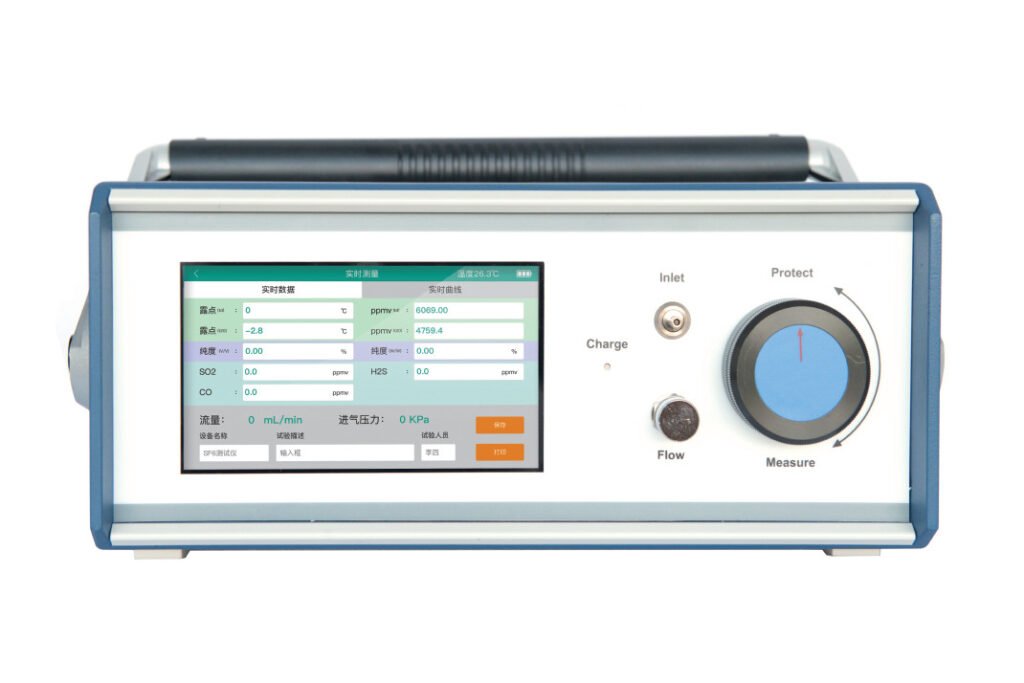
For SF6 Purity, you need a range of 0 to 100%. Why? Because sometimes you are testing new gas cylinders which must be >99.9%, and other times you are testing a leaking breaker that might have air mixed in, dropping purity to 80% or lower. A narrow range will limit your ability to diagnose severe leaks.
For Dew Point (Moisture), the range is critical. Water is the biggest enemy of insulation. You need a device that can measure very dry gas, down to -60°C. If your analyzer stops at -30°C, you might miss early warning signs of moisture ingress. On the upper end, it needs to read up to +20°C so you can detect wet gas during the vacuum and filling process.
For Decomposition Products, standard analyzers measure SO2, H2S, and HF. The typical range is 0 to 100 ppm. This is usually enough for routine maintenance because healthy equipment has 0 ppm. However, if a major arc fault occurs, these levels can spike to 500 ppm or more. Therefore, having a wider range can help you understand the severity of the internal damage. Here is a breakdown of the standard ranges we recommend for general utility applications:
| Parameter | Standard Measuring Range | Why This Range is Important |
| SF6 Purity (Vol %) | 0% to 100% | Allows testing of both pure gas supplies and heavily contaminated compartments. |
| Dew Point (Moisture) | -60°C to +20°C | Detects very dry insulation conditions and high humidity levels during maintenance. |
| SO2 (Sulfur Dioxide) | 0 to 100 ppm | Detects spark discharges and early signs of overheating. |
| H2S (Hydrogen Sulfide) | 0 to 100 ppm | Identifies specific types of material breakdown inside the switchgear. |
| HF (Hydrogen Fluoride) | 0 to 50 ppm | This is highly toxic; even small ranges are vital for worker safety. |
How Accurate Are SF6 Gas Analyzers in Detecting Decomposition Products?
If your analyzer gives you a wrong reading, you might open a toxic tank without protection or shut down a healthy station for no reason. Accuracy is the difference between safe operation and a dangerous accident. You should prioritize analyzers with an accuracy of ≤1% Full Scale (FS) for decomposition products and ±0.5°C for dew point precision. High-quality units also use built-in pressure compensation and automated calibration to ensure that temperature changes in the field do not distort the results.
Accuracy is the most expensive part of the specification sheet, but it is worth the investment. For decomposition products like SO2, an accuracy of ±1 ppm or ±1% Full Scale is the industry standard for high-end equipment. Cheaper sensors might drift by 5-10%, which is dangerous. If the real value is 8 ppm (unsafe) but your device reads 4 ppm (safe), you put your maintenance team at risk of inhaling toxic fumes. Pressure compensation is another feature I always highlight. SF6 gas volume changes with pressure and temperature.
If you test a breaker in a hot desert in Saudi Arabia, the gas behaves differently than in a cold winter in Russia. Advanced analyzers have internal sensors that measure the sample pressure and temperature, then mathematically correct the result. This ensures that the “ppm” value you see on the screen is accurate regardless of the environment.
Dew point accuracy is equally vital. A shift of just 2 or 3 degrees can mean the difference between passing and failing IEC standards. We use chilled mirror or high-grade polymer sensors to achieve ±0.5°C accuracy. This precision prevents false alarms that waste time, and it prevents missed failures that destroy transformers. I have created a table to show you the difference between standard and high-precision specifications:
| Tính năng | Standard Accuracy | High-Precision Accuracy | Benefit of High Precision |
| Điểm sương | ±2.0°C | ±0.5°C | Avoids false positives; critical for meeting strict utility audits. |
| SF6 Purity | ±1.0% | ±0.5% | Ensures you don’t waste expensive gas by replacing it too early. |
| Decomposition (SO2) | ±5% Full Scale | ±1% Full Scale | detecting tiny traces of arcing before the equipment fails. |
| Flow Rate Control | Manual Valve | Automatic Electronic Flow | Protects sensors from pressure shocks and ensures consistent sampling. |
| Hiệu chuẩn | Manual | Automatic / Self-check | Reduces the need to send the unit back to the factory frequently. |
What Are the Differences Between Portable and Stationary SF6 Analyzers?
You need to decide if you want to move the tester to the equipment or leave it there permanently. This choice depends entirely on your maintenance strategy and the criticality of your assets. Portable analyzers are designed for field technicians to carry between substations for periodic testing, while stationary analyzers are fixed monitors that provide 24/7 data for critical assets. Portable units prioritize battery life and weight, whereas stationary units focus on connectivity and continuous trend analysis.
At KV HIPOT, most of our international clients prefer portable units. This is because they are contractors or maintenance teams responsible for dozens of substations. A portable unit typically weighs between 5kg and 15kg. It has a built-in battery, a carrying handle, and a rugged case to survive transport in a truck. The key benefit is flexibility. You can use one device to test a circuit breaker today and a transformer tomorrow.

However, stationary (online) monitoring is growing in popularity for “super-critical” assets. If you have a main step-up transformer at a nuclear plant, you cannot wait for a yearly check. You need to know the second a leak starts. Stationary systems connect directly to the SCADA system. They run on mains power and do not need a technician to operate them. The downside is the cost; you need one unit per gas compartment, which gets very expensive. Another major difference is gas consumption.
Portable units use a small amount of gas for the test and then stop. Stationary units often use a pump-back system to cycle the gas, or they use diffusion sensors that don’t consume gas at all. This is important because SF6 is expensive and regulated. Here is a comparison to help you decide which form factor fits your business model:
| Tính năng | Portable Analyzer | Stationary (Online) Monitor |
| Primary Use | Routine maintenance, troubleshooting, and commissioning. | Continuous health monitoring of critical assets. |
| Power Source | Rechargeable Battery (AC backup). | 110V/220V Mains Power. |
| Portability | High (Handheld or case-mounted). | None (Fixed installation). |
| Data Access | Screen, USB export, or Thermal Printer. | SCADA integration, Ethernet, Modbus. |
| Chi phí | Lower initial investment (one unit for many sites). | High investment (one unit per compartment). |
| Response Time | Fast (2-5 minutes per test). | Real-time (Continuous). |
Which Certifications (IEC, ASTM) Apply to SF6 Gas Analyzers?
Buying equipment that does not meet international standards is a waste of money. Your test reports will be rejected by the grid operator if your analyzer does not comply with the global rules for gas handling. The most critical standards are IEC 60480 for checking used gas quality and IEC 60376 for verifying new gas.
Additionally, ASTM D2472 is used in some regions. Your analyzer’s detection limits and accuracy must meet the strict thresholds defined in these documents to be considered compliant. IEC 60480 is the “Bible” for maintenance engineers. It defines the limits for when SF6 gas can be reused and when it must be scrapped. For example, it might state that moisture must be below a certain ppm level.
If your analyzer is not accurate enough to measure that level, you cannot certify the equipment. We also see requirements for EMC (Electromagnetic Compatibility) certification. Substations have huge magnetic fields. If your analyzer is not shielded properly, the interference will cause the screen to flicker or the readings to jump. This is why CE certification is important—it proves the device is safe to use in an industrial electrical environment.
Another aspect is the traceability of calibration. Standards like ISO 17025 require that your analyzer is calibrated against a known master standard. When you buy from us, we provide a calibration certificate. This paper trail proves to your client that your measurements are real. I have summarized the key standards you will see in tender documents:
| Standard Code | Name / Description | Why Your Analyzer Needs This |
| IEC 60480 | Guidelines for checking and treatment of sulfur hexafluoride (SF6) taken from electrical equipment. | Defines the pass/fail limits for used gas. Your tool must read these limits accurately. |
| IEC 60376 | Specification of technical grade sulfur hexafluoride (SF6) for use in electrical equipment. | Used when commissioning new equipment to prove the gas is 99.9% pure. |
| CIGRE Guide | Technical brochures on SF6 handling. | often referenced in best-practice guides for decomposition product analysis. |
| CE Marking | European Conformity (EMC and Low Voltage Directive). | Ensures the device won’t malfunction due to electrical noise in the substation. |
| ASTM D2472 | Standard Specification for Sulfur Hexafluoride. | Common in American markets; similar to IEC but with slightly different parameters. |
Kết luận
Selecting the right SF6 gas analyzer requires attention to detail. You must ensure the device covers the necessary measuring ranges for purity, dew point, and decomposition products. Accuracy is non-negotiable; look for ≤1% error margins to ensure safety and IEC 60480 compliance. Finally, decide between portable flexibility and stationary monitoring based on your specific site requirements.
At KV HIPOT, we design our analyzers to meet these rigorous technical standards while keeping them easy for field engineers to use. We know that accurate data is the foundation of electrical safety.
By choosing a compliant, high-precision analyzer, you protect your valuable substation assets and, most importantly, the people who work on them. If you need help matching these specs to your project needs, our engineering team is ready to assist.



 English
  ไทย
ไทย  Tiếng Việt
  العربية
  Русский
  Italiano
  Español
  한국어
한국어  Português do Brasil
  Français
  Español de México
  Português
  Türkçe
  Čeština
  Español de Argentina
  Slovenčina
  Dansk
Dansk  Polski
  Deutsch
  Ελληνικά
  O‘zbekcha
  Bahasa Indonesia
  Română