

Where Is VLF Cable Testing Used Across Power and Infrastructure Projects?
Cable failures are costly, but the wrong VLF assumption can waste an outage, misclassify insulation, or expose a test crew to avoidable risk.
Utilities use planned VLF withstand or diagnostic work to support acceptance, maintenance prioritization, and investigation of shielded distribution circuits. Equipment selection and interpretation must also account for cable voltage, capacitance, waveform, condition, and the approved procedure.
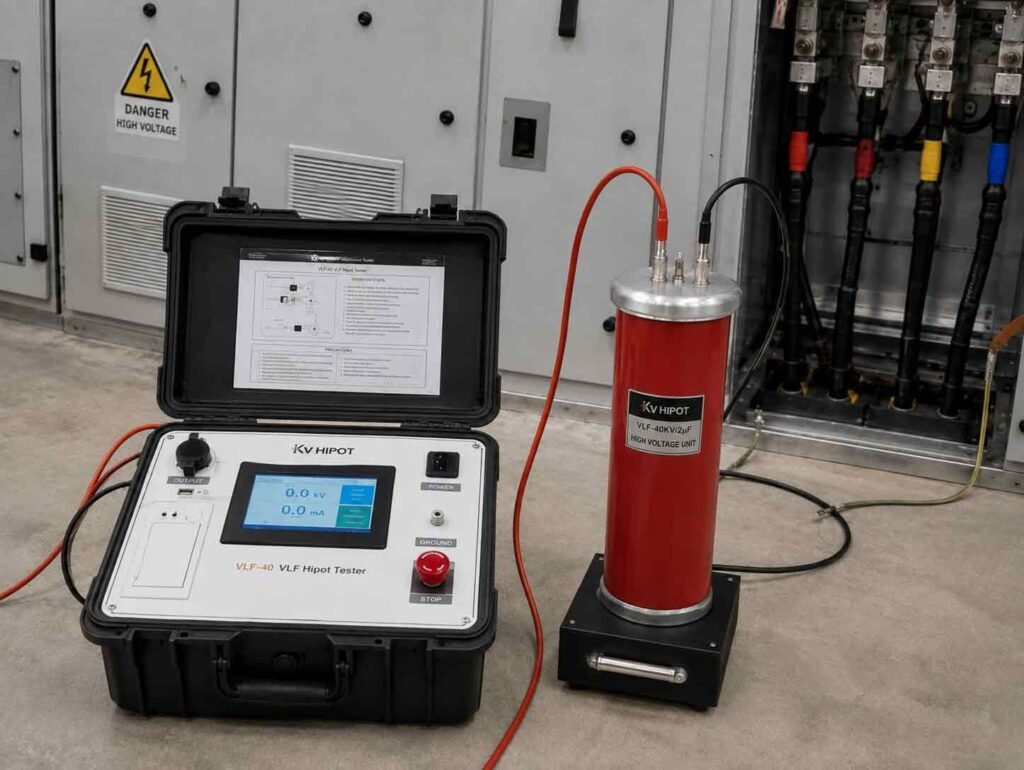
The practical issue is not simply whether VLF testing works. The chosen method must produce evidence the responsible engineer can use. The following six questions explain the decisions that matter for this application.
How do utilities use VLF testing for underground distribution cables?
Applying one utility test template to every underground feeder can ignore differences in cable age, accessories, and maintenance consequence.
Utilities use planned VLF withstand or diagnostic work to support acceptance, maintenance prioritization, and investigation of shielded distribution circuits.
Utility Acceptance and Maintenance Programs
Start by separating the engineering question from the equipment label. The same phrase can describe acceptance testing, maintenance screening, or a diagnostic investigation, yet those activities produce different evidence. Define the asset, cable construction, accessories, service condition, test objective, and decision owner. That boundary prevents a technically correct measurement from being used to support the wrong decision. It also clarifies which connected equipment must be isolated and which records must be available before the test team arrives.
A practical review should challenge three assumptions. First, confirm that the term being used means the same thing to the owner, contractor, and equipment supplier. Second, check that the test circuit includes joints and terminations, not merely a theoretical cable length. Third, verify that the intended result can be accepted under the contract or maintenance program. These checks are inexpensive and often reveal scope gaps before they consume an outage.
Turn this boundary into a one-page scope statement. Name the asset, the decision the test must support, the governing document, exclusions, and the person authorized to accept the result. Add the article’s central insight as a review rule: Industry changes the purpose and logistics of testing more than the electrical principle; specify the workflow around consequence of failure and site constraints. A signed scope statement gives the field team a practical checkpoint and exposes disagreements before they affect safety, schedule, or cable condition.
Why do EPC contractors use VLF tests during cable commissioning?
Poorly planned commissioning tests can delay EPC handover even when installation work is otherwise complete.
EPC teams need traceable evidence that installed cable systems and accessories meet the project’s approved commissioning procedure.

Commissioning Evidence for EPC Handover
Start by separating the engineering question from the equipment label. The same phrase can describe acceptance testing, maintenance screening, or a diagnostic investigation, yet those activities produce different evidence. Define the asset, cable construction, accessories, service condition, test objective, and decision owner. That boundary prevents a technically correct measurement from being used to support the wrong decision. It also clarifies which connected equipment must be isolated and which records must be available before the test team arrives.
A practical review should challenge three assumptions. First, confirm that the term being used means the same thing to the owner, contractor, and equipment supplier. Second, check that the test circuit includes joints and terminations, not merely a theoretical cable length. Third, verify that the intended result can be accepted under the contract or maintenance program. These checks are inexpensive and often reveal scope gaps before they consume an outage.
Turn this boundary into a one-page scope statement. Name the asset, the decision the test must support, the governing document, exclusions, and the person authorized to accept the result. Add the article’s central insight as a review rule: Industry changes the purpose and logistics of testing more than the electrical principle; specify the workflow around consequence of failure and site constraints. A signed scope statement gives the field team a practical checkpoint and exposes disagreements before they affect safety, schedule, or cable condition.
How is VLF testing applied in wind, solar and battery storage projects?
Long renewable collector circuits can exceed source capacity when capacitance is estimated from voltage class alone.
Collector circuits connect dispersed generation and storage assets, often creating long cable runs, remote logistics, and tight energization milestones.
Collector-Circuit Testing for Renewable Projects
Start by separating the engineering question from the equipment label. The same phrase can describe acceptance testing, maintenance screening, or a diagnostic investigation, yet those activities produce different evidence. Define the asset, cable construction, accessories, service condition, test objective, and decision owner. That boundary prevents a technically correct measurement from being used to support the wrong decision. It also clarifies which connected equipment must be isolated and which records must be available before the test team arrives.
A practical review should challenge three assumptions. First, confirm that the term being used means the same thing to the owner, contractor, and equipment supplier. Second, check that the test circuit includes joints and terminations, not merely a theoretical cable length. Third, verify that the intended result can be accepted under the contract or maintenance program. These checks are inexpensive and often reveal scope gaps before they consume an outage.
Turn this boundary into a one-page scope statement. Name the asset, the decision the test must support, the governing document, exclusions, and the person authorized to accept the result. Add the article’s central insight as a review rule: Industry changes the purpose and logistics of testing more than the electrical principle; specify the workflow around consequence of failure and site constraints. A signed scope statement gives the field team a practical checkpoint and exposes disagreements before they affect safety, schedule, or cable condition.
| Decision area | Verify | Why it matters |
|---|---|---|
| Utility | Repeatable asset records | Acceptance and maintenance planning |
| EPC | Project procedure and handover report | Commissioning evidence |
| Industrial | Short outage and rapid setup | Continuity and risk control |
| Renewable | Long collector circuits and remote sites | Energization and lifecycle testing |
Where does VLF testing fit in railway, airport and tunnel power systems?
Testing critical transport power systems without outage and contingency planning can disrupt services far beyond the cable circuit.
Transport infrastructure values portable equipment, controlled outages, clear records, and procedures coordinated with safety-critical operations.
Testing Critical Transport Power Networks
Start by separating the engineering question from the equipment label. The same phrase can describe acceptance testing, maintenance screening, or a diagnostic investigation, yet those activities produce different evidence. Define the asset, cable construction, accessories, service condition, test objective, and decision owner. That boundary prevents a technically correct measurement from being used to support the wrong decision. It also clarifies which connected equipment must be isolated and which records must be available before the test team arrives.
A practical review should challenge three assumptions. First, confirm that the term being used means the same thing to the owner, contractor, and equipment supplier. Second, check that the test circuit includes joints and terminations, not merely a theoretical cable length. Third, verify that the intended result can be accepted under the contract or maintenance program. These checks are inexpensive and often reveal scope gaps before they consume an outage.
Turn this boundary into a one-page scope statement. Name the asset, the decision the test must support, the governing document, exclusions, and the person authorized to accept the result. Add the article’s central insight as a review rule: Industry changes the purpose and logistics of testing more than the electrical principle; specify the workflow around consequence of failure and site constraints. A signed scope statement gives the field team a practical checkpoint and exposes disagreements before they affect safety, schedule, or cable condition.
How do factories and data centers use VLF testing during planned outages?
Industrial and data-center tests that exceed the outage window can create more operational risk than the planned maintenance removes.
Industrial and data-center owners test during limited outages, so setup time, load capability, reporting, and contingency planning strongly affect value.
Planning Tests Around Industrial Outages
Start by separating the engineering question from the equipment label. The same phrase can describe acceptance testing, maintenance screening, or a diagnostic investigation, yet those activities produce different evidence. Define the asset, cable construction, accessories, service condition, test objective, and decision owner. That boundary prevents a technically correct measurement from being used to support the wrong decision. It also clarifies which connected equipment must be isolated and which records must be available before the test team arrives.
A practical review should challenge three assumptions. First, confirm that the term being used means the same thing to the owner, contractor, and equipment supplier. Second, check that the test circuit includes joints and terminations, not merely a theoretical cable length. Third, verify that the intended result can be accepted under the contract or maintenance program. These checks are inexpensive and often reveal scope gaps before they consume an outage.
Turn this boundary into a one-page scope statement. Name the asset, the decision the test must support, the governing document, exclusions, and the person authorized to accept the result. Add the article’s central insight as a review rule: Industry changes the purpose and logistics of testing more than the electrical principle; specify the workflow around consequence of failure and site constraints. A signed scope statement gives the field team a practical checkpoint and exposes disagreements before they affect safety, schedule, or cable condition.
What changes when testing long export, inter-array or offshore cables?
Long export and offshore circuits can make ordinary field configurations impractical unless load, logistics, and repair access are planned together.
Long and offshore circuits increase capacitance, access difficulty, repair consequences, environmental exposure, and the need for project-specific engineering.
Managing Long and Highly Capacitive Circuits
Start by separating the engineering question from the equipment label. The same phrase can describe acceptance testing, maintenance screening, or a diagnostic investigation, yet those activities produce different evidence. Define the asset, cable construction, accessories, service condition, test objective, and decision owner. That boundary prevents a technically correct measurement from being used to support the wrong decision. It also clarifies which connected equipment must be isolated and which records must be available before the test team arrives.
A practical review should challenge three assumptions. First, confirm that the term being used means the same thing to the owner, contractor, and equipment supplier. Second, check that the test circuit includes joints and terminations, not merely a theoretical cable length. Third, verify that the intended result can be accepted under the contract or maintenance program. These checks are inexpensive and often reveal scope gaps before they consume an outage.
Turn this boundary into a one-page scope statement. Name the asset, the decision the test must support, the governing document, exclusions, and the person authorized to accept the result. Add the article’s central insight as a review rule: Industry changes the purpose and logistics of testing more than the electrical principle; specify the workflow around consequence of failure and site constraints. A signed scope statement gives the field team a practical checkpoint and exposes disagreements before they affect safety, schedule, or cable condition.

 English
  ไทย
ไทย  Tiếng Việt
  العربية
  Русский
  Italiano
  Español
  한국어
한국어  Português do Brasil
  Français
  Español de México
  Português
  Türkçe
  Čeština
  Español de Argentina
  Slovenčina
  Dansk
Dansk  Polski
  Deutsch
  Ελληνικά
  O‘zbekcha
  Bahasa Indonesia
  Română