

The Comprehensive Guide to Battery Discharge Testers: Principles and Procedures?
Power outages destroy data and stop factory lines. You worry your backup batteries will fail when needed. A battery discharge tester proves your batteries work before the grid fails. A battery discharge tester is an electronic load device used to measure the true capacity of backup batteries. It pulls a constant current from the battery until a cutoff voltage. This test finds dead cells and proves the battery can support your critical systems during a real power outage. You will lose millions of dollars if your backup power fails during a blackout. Do not wait for a disaster to check your power systems. You must read the next sections to learn how to test your batteries correctly.
What is a battery discharge tester used for?
You fear a total system crash during a blackout. Dead backup batteries cause massive downtime. You use a battery discharge tester to find weak cells early. A battery discharge tester draws a physical, constant current from a stationary battery string. It measures the exact State of Health. This IEEE-approved method proves definitively whether your batteries can carry the critical load when the main power stops. !
Finding the Weak Links in Your Power Chain
I visit many large data centers and power plants. Facility managers always show me their battery rooms. The batteries look new and clean on the outside. But visual checks mean nothing. You cannot see the chemical health inside the plastic box. You use a battery discharge tester from KVHIPOT to pull real power from the string. Many engineers rely on simple voltage checks. This is a big mistake. A battery can show perfect voltage when it rests. It drops to zero immediately under a real load. Our discharge tester acts like your actual factory machines. It pulls power for hours. This test forces every single cell to work hard. The weak cells drop their voltage fast. You spot the bad batteries and replace them. You save the whole system from failing.
| Testing Method | What It Measures | Accuracy Level | Real World Value |
|---|---|---|---|
| Visual Check | Dirt and leaks | Very Low | Only finds physical damage |
| Float Voltage | Resting power | Low | Cannot predict load capacity |
| Discharge Test | True capacity | Very High | Proves actual backup time |
You must use this machine for annual maintenance. It gives you raw data. You use this data to buy replacement cells.
How does a constant current discharge test work?
Unstable testing loads give you bad data. You might think a broken battery is good. A constant current test keeps the load perfectly steady. A constant current discharge test works by pulling the exact same amount of amps from the battery over time. The tester automatically adjusts its internal resistance as the battery voltage drops. This keeps the current flat and ensures an accurate calculation of the total battery capacity.
Maintaining a Steady Load for Accurate Data
You must understand the chemistry of a battery. The voltage goes down as the battery loses power. A simple resistor cannot keep the current steady. If the voltage drops, the current drops too. This makes your math wrong. Our KVHIPOT battery discharge tester uses smart computer controls to fix this problem. The tester acts as a smart electronic load. You type the target current on the screen. Let us say you want 50 amps. The battery starts at 54 volts. The machine pulls 50 amps. Two hours later, the battery drops to 48 volts. The machine changes its resistance inside. It still pulls exactly 50 amps. This constant pull is the only way to measure real capacity.
| Time Passed | Battery Voltage | Machine Resistance | Current Pulled |
|---|---|---|---|
| 0 Hours | 54.0 V | High | 50 Amps |
| 2 Hours | 50.0 V | Medium | 50 Amps |
| 4 Hours | 46.0 V | Low | 50 Amps |
You set the current based on the battery manual. The machine runs the test safely. It stops automatically. You get a perfect graph of the battery health.
Why is battery discharge testing necessary for UPS systems?
A sudden power cut stops your hospital equipment. Your UPS fails because the batteries are secretly dead. You must test the UPS batteries to save lives and money. Battery discharge testing is necessary for UPS systems because it is the only way to guarantee backup time. UPS batteries lose capacity over time. A full discharge test reveals the true run time, ensuring your critical systems stay online during an emergency power failure.
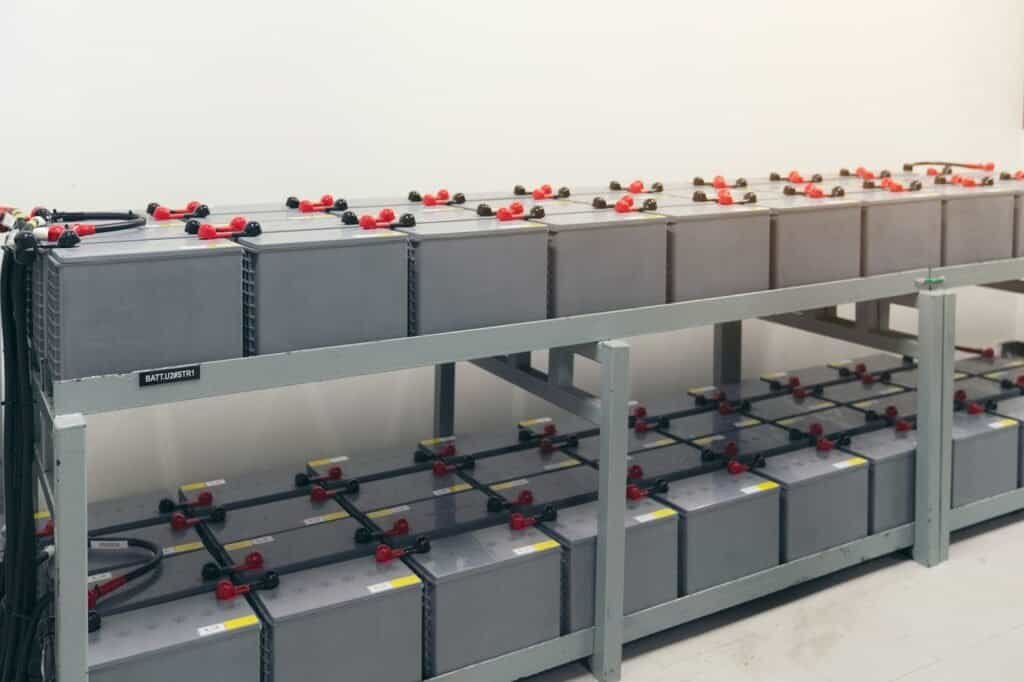
Protecting Critical Infrastructure from Blackouts
I talk to many IT directors. They buy very expensive UPS machines. They think they are safe. I always ask them about their batteries. The UPS is just a smart switch. The batteries do all the heavy lifting. If the grid fails, the UPS needs raw power from the batteries. UPS batteries sit in a warm room for years. The acid inside dries up. The metal plates get old. The UPS screen might say the batteries are 100 percent full. This screen often lies. The screen only measures the float voltage. It does not know the real chemical health. You must attach our discharge tester to the battery string. You must pull power from them to see if they can hold the load.
| UPS Component | Function | Failure Risk | Best Testing Method |
|---|---|---|---|
| Inverter | Changes DC to AC | Low | Internal diagnostics |
| Control Board | Manages switching | Low | Annual service check |
| Battery String | Provides raw power | Very High | Full discharge test |
You run this test to protect your business. A bank cannot lose its computers. A hospital cannot lose its lights. You test the UPS batteries to know your exact safe time. You sleep well at night when you know the true SOH.
What is the difference between a discharge test and an impedance test?
You use quick tests and get wrong answers. You buy new batteries when you do not need them. You must know the difference between real tests and math guesses. The difference is that an impedance test sends a quick AC signal to estimate battery resistance. A discharge test draws physical, constant current for hours. It provides absolute, empirical data about the exact capacity of the battery.
Choosing the Right Tool for Battery Maintenance
Many engineers ask me which test is better. They like the impedance test because it takes two seconds per cell. You use a small handheld tool. You touch the battery posts. The tool gives you a number. You write it down. This is good for a quick monthly check. But it does not tell you if the battery will work for three hours during a blackout. The impedance test only finds broken connections inside the cell. It uses math to guess the capacity. Math guesses are often wrong. The discharge test is completely different. You connect a large machine. You drain the battery on purpose. This takes hours. It is hard work. But this is the only IEEE-approved method. It gives you 100 percent true facts.
| Test Feature | Impedance Test | Discharge Test |
|---|---|---|
| Sinov davomiyligi | 5 seconds per cell | 3 to 10 hours total |
| Data Type | Mathematical estimation | Empirical physical data |
| Load Type | Tiny AC signal | Heavy DC constant current |
| Accuracy | Good for quick trends | Perfect for exact capacity |
I tell my clients to use both. You use the quick test every month. You use the KVHIPOT discharge tester once a year. This combination gives you perfect control over your power system.
What are the standard cutoff voltages for 2V and 12V cells?
You drain your batteries too low and destroy them. You drain them too little and get bad test results. You must set the exact cutoff voltage to test safely. The standard cutoff voltage depends on the discharge rate. For a 2V cell, the standard cutoff is usually 1.80V. For a 12V battery block, the cutoff is typically 10.5V. You must stop the test at these exact limits to prevent permanent damage to the cells.
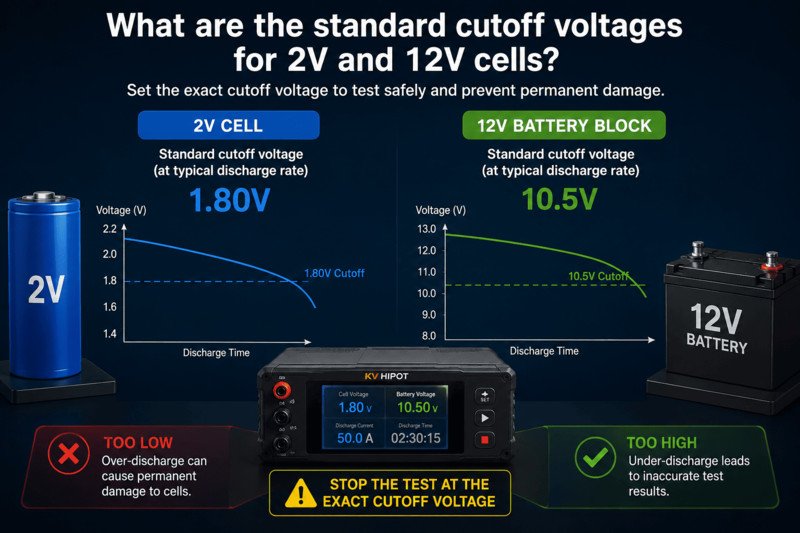
Protecting Batteries During the Discharge Process
You must be very careful when you test batteries. If you take too much power out, the battery will never charge again. The chemical plates will bend and break. We call this a deep discharge. You must use the KVHIPOT tester to stop the test automatically. You program the cutoff voltage into the machine before you press start. Different batteries have different rules. A large data center uses big 2-volt cells. A small office UPS uses small 12-volt blocks. You must read the factory manual for your specific battery. The time rate also changes the limit. If you pull power fast in one hour, the cutoff is lower. If you pull power slowly over ten hours, the cutoff is higher.
| Battery Type | 10-Hour Rate Cutoff | 3-Hour Rate Cutoff | 1-Hour Rate Cutoff |
|---|---|---|---|
| 2V Cell | 1.80 V | 1.75 V | 1.70 V |
| 6V Block | 5.40 V | 5.25 V | 5.10 V |
| 12V Block | 10.8 V | 10.5 V | 10.2 V |
I helped a telecommunications company in Africa last month. They set the cutoff too low for their 2V cells. They almost ruined their entire string. I showed them how to set the 1.80V limit on our machine. The machine monitors every cell. If one single cell hits 1.80V, the machine rings an alarm and stops. This protects your expensive investment.
How do you calculate battery capacity after a discharge test?
You finish the long test but do not understand the numbers. Bad math gives you a false sense of safety. You must calculate the capacity perfectly to know the truth. You calculate battery capacity by multiplying the constant discharge current by the total test time. If you draw 50 amps for 8 hours before hitting the cutoff voltage, the actual capacity is 400 Amp-hours. You compare this tested capacity to the factory rating to find the state of health. Turning Raw Data into Clear Decisions
You run the test to get clear answers. You want to know if you should keep the battery or buy a new one. The math is actually very simple. You only need two numbers. You need the current you pulled. You need the time the battery lasted. Our discharge tester records these numbers perfectly. It creates a simple report for you. Let us look at a real example. You have a battery rated for 500 Amp-hours (Ah) at the 10-hour rate. This means it should give 50 amps for 10 hours. You run the test at 50 amps. The battery reaches the cutoff voltage after only 8 hours. You multiply 50 amps by 8 hours. The result is 400 Ah. This is your real capacity.
| Step | Action | Example Math | Result |
|---|---|---|---|
| 1 | Find test current | Look at tester screen | 50 Amps |
| 2 | Find total run time | Look at test clock | 8 Hours |
| 3 | Multiply them | 50 A x 8 H | 400 Ah (Real Capacity) |
| 4 | Find State of Health | (400 Ah / 500 Ah) x 100 | 80% SOH |
You must look at the State of Health percentage. IEEE standards say a battery is dead when it hits 80 percent of its factory rating. In this example, the battery is exactly at 80 percent. You must order a replacement immediately. You cannot trust this battery to support your factory during a blackout.
Xulosa
You use a battery discharge tester to pull constant current and measure true capacity. This proves your UPS batteries can survive a real blackout and keeps your systems safe.


 English
  ไทย
ไทย  Tiếng Việt
  العربية
  Русский
  Italiano
  Español
  한국어
한국어  Português do Brasil
  Français
  Español de México
  Português
  Türkçe
  Čeština
  Español de Argentina
  Slovenčina
  Dansk
Dansk  Polski
  Deutsch
  Ελληνικά
  O‘zbekcha
  Bahasa Indonesia
  Română