

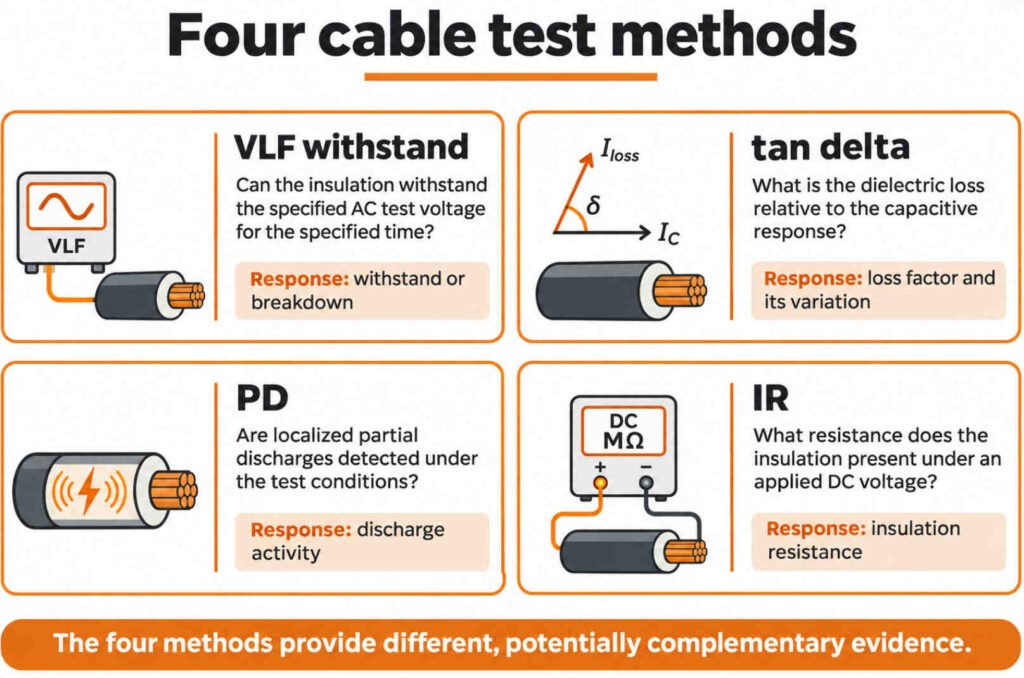
VLF withstand, tan delta, partial discharge and insulation resistance tests examine different aspects of a cable system. Withstand assesses survival of specified electrical stress; tan delta measures overall dielectric-loss behavior; PD examines detected localized discharge activity; insulation resistance evaluates a defined DC response. Select them for complementary questions. A favorable result from one method does not automatically replace another required measurement or cancel a valid concern from a different method.
This distinction matters when a contractor receives a request for “VLF testing” and the customer expects an insulation condition assessment. The contractor may supply a valid withstand record yet leave the customer’s actual question unanswered. It also matters when a buyer assumes a VLF source automatically includes a tan delta measurement system or a partial discharge detector.
Distinguish the electrical stimulus from the quantity measured
A voltage source establishes an electrical stimulus. A measuring system observes a response. A procedure defines how the stimulus and response are used. Calling all three “VLF” hides information needed to specify and interpret the work. For example, a suitable very low frequency source can be part of a withstand test or a diagnostic arrangement. However, observing voltage and current does not automatically mean that phase-sensitive dielectric loss or discharge pulses have been measured. Those functions require the appropriate measurement chain and operating configuration. For a purchase order, name the required result. “VLF source” identifies a component. “VLF withstand report under the agreed procedure” identifies an assignment. “Tan delta readings with recorded test conditions and interpretation” identifies a diagnostic deliverable. If all are required, list them separately and verify that the supplied hardware and software support each.
A completed withstand test establishes whether the tested assembly withstood the specified stress for the specified duration under the documented procedure. Its meaning depends on those conditions and the actual test boundary. A passing record cannot be detached from the assembly, waveform and procedure that produced it. This makes withstand useful where the engineering requirement is to demonstrate performance under an agreed test. It does not turn the result into a prediction of remaining service life. Nor does it show that every possible defect mechanism has been excluded. Also distinguish a completed test from an interrupted test. If the source trips, the software loses the record or a required stage is not completed, the reason and available evidence must be preserved. The report should not silently convert an incomplete assignment into a completed pass or presume that every interruption means insulation breakdown.
The practical question for the contractor is therefore precise: can another engineer reconstruct what was applied, to what assembly, for how long, and with what observed outcome? The IEEE 400.2-2024 guide covers field VLF withstand and diagnostic measurements on shielded cable systems. The applicable complete procedure supplies the test conditions and evaluation basis; its public scope is not an acceptance-threshold table.
Choose methods for complementary questions
Tan delta evaluates dielectric loss rather than merely recording survival of a test. In a simplified sinusoidal parallel resistance-capacitance model, it is the ratio of resistive to capacitive current. This helps explain why phase information matters and why total current alone is not the same measurement. Ask what is included in the measurement: cable sections, accessories and any relevant interfaces. Then check whether the comparison basis matches the insulation construction and test conditions.
Comparing two displayed numbers without checking frequency, waveform, voltage basis and configuration can produce an apparent trend that is not a valid condition trend. Units deserve particular attention. As an arithmetic example, a dimensionless value of 0.002 equals 0.2%, or 2 when displayed on a scale labelled 10^-3. These are three representations of the same quantity, not three different insulation conditions. This example is a unit conversion, not an acceptance criterion. A useful report retains the underlying observations and their conditions, not only a colour assigned by software. If the evaluation basis is unsuitable or the measurement configuration uncertain, the correct conclusion may be that interpretation is not yet supported. That is different from condemning the cable.
| Test method | What it means | Practical implication |
|---|---|---|
| VLF withstand | Survival under specified stress and duration | Does not predict a failure-free service interval |
| Tan delta | Overall dielectric-loss behavior | Does not independently locate a defective joint |
| Partial discharge | Detected localized discharge activity | Interpretation depends on method, sensitivity and interference |
| Insulation resistance | Response to a defined DC measurement | Does not substitute for specified AC diagnostic evidence |
Partial discharge measurement examines local discharge activity. Depending on the method and arrangement, it can contribute information about sources and their location. It should not be reduced to a claim that every defective cable must produce a clearly recognisable signal in every field measurement. Noise matters because the required signals can be small relative to interference. A reported absence of detected activity needs context: the measurement arrangement, sensitivity, interference conditions and applicable interpretation.
A clear-looking plot is not sufficient if the team cannot explain how unwanted signals were distinguished from the activity of interest. For procurement, ask whether the proposed system is intended for the particular application, not simply whether the brochure contains the letters PD. Coupling arrangement, signal acquisition, interpretation capability and reporting form part of the usable solution. Insulation resistance is inferred from voltage and current in a defined DC measurement. It provides a different kind of evidence from AC dielectric loss or discharge activity. A favourable resistance value does not automatically fulfil a requirement for another method.
Keep the recorded test conditions with the value, including the test object and measurement timing. Treat changes in the circuit configuration or procedure as relevant to comparison. A resistance result copied into a certificate without its conditions offers little help when the next engineer tries to reconcile it with other findings. Avoid universal internet rules that turn a single resistance value into permission to energise every cable. The applicable equipment, construction, requirements and approved assessment matter. Likewise, do not assume that every test informally called a “megger” refers to the same instrument range or procedure.
Application example: interpreting apparently conflicting results
Imagine a retained industrial feeder has a high insulation-resistance reading, completes the required VLF withstand test and produces a concerning tan delta pattern under an applicable assessment method. The scenario is illustrative and includes no acceptance numbers. A project manager may ask why three tests do not produce one consistent “good” or “bad” label. The answer begins with the measured quantities: the tests do not observe the same response, and a favorable result in one does not cancel a valid concern in another.
First establish that all results refer to the same cable assembly and that each measurement is valid for its own method. Insulation resistance describes a DC response. Withstand records survival of an applied stress. Tan delta characterizes AC dielectric loss. If the loss concern remains, select follow-up according to the unresolved mechanism or location question. A suitable PD investigation may add information about discharge activity, but an absence of detected PD would not automatically negate a loss concern. The measurement sensitivity, noise environment and test conditions must be considered before assigning meaning to that absence.
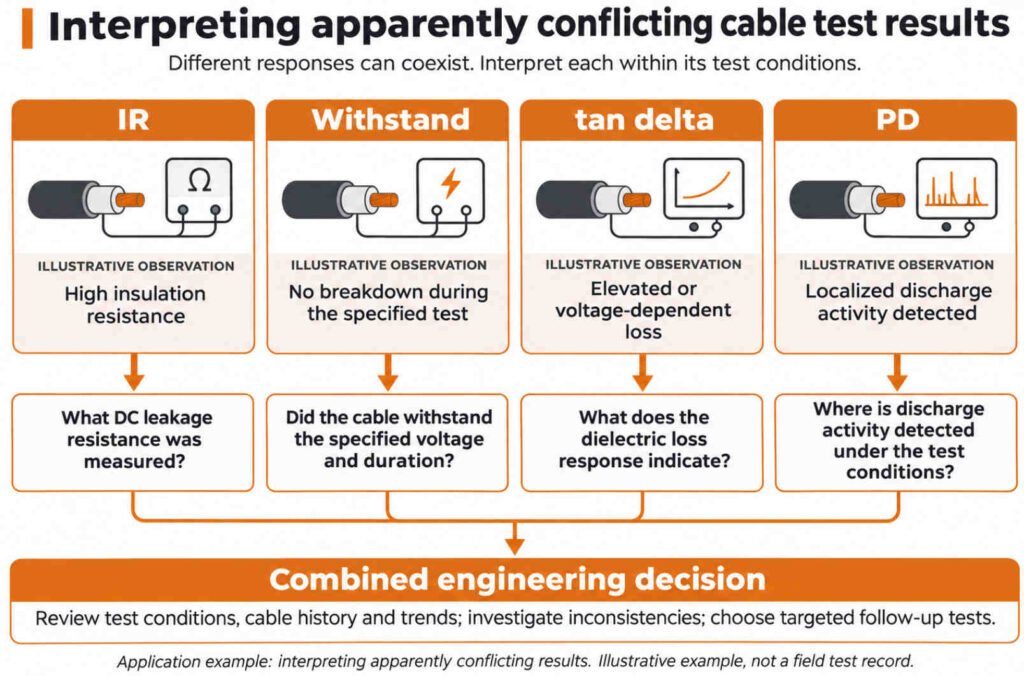
The useful conclusion preserves the distinct findings and identifies which one changes the next action. It does not average resistance, loss ratio and discharge quantities into a made-up health score. For a new cable installation, the required acceptance programme may differ from a retained feeder investigation; the same list of instruments should not be imposed on both without a reason. Procurement becomes clearer when the owner states the question and deliverable first. The appropriate source, measuring functions and specialist support then follow from that scope.
Why unlike measurements cannot be averaged into cable health
First confirm that the results refer to the same assembly. A test before retermination and a test after retermination do not include an identical system. An intermediate joint replacement, changed test interface or different isolation boundary can also make a simple comparison misleading. Next check the validity of each measurement separately. A completed withstand record should have its own traceable conditions. A tan delta record needs an appropriate configuration and evaluation basis. A PD observation needs sufficient information about signal discrimination and measurement sensitivity. A resistance value needs its own measurement context. Only then combine the findings. Consider three hypothetical patterns. Withstand passes while valid tan delta observations raise concern: the withstand result remains evidence of the completed test, while the diagnostic concern requires its own evaluation. Tan delta appears unremarkable while credible local PD activity is identified: an overall measurement does not cancel local evidence. No interpretable PD result is available because of unresolved interference: that is a limitation, not a zero-defect result.
Do not calculate an average of unlike measurements to force an answer. Ohms, a dielectric loss ratio and a discharge-related quantity cannot be averaged into a meaningful health score without a separately defined and validated model. More decimal places do not solve that problem. The resulting recommendation should explain which observation changes the decision and which uncertainty remains. If follow-up is proposed, state what it must resolve. “Repeat all tests” is less useful than identifying the specific result whose validity or interpretation is unresolved.
Start with the asset and purpose. Is this a new installation, retained feeder, post-repair assessment or investigation of a particular concern? Identify the governing project documents and the responsible reviewer before selecting equipment from a catalogue. Then separate the deliverables. Specify which methods are required, the applicable approved procedures, the measurements and raw records to retain, and the form of the interpretation. Do not use “complete cable testing” as a substitute for this detail.
Specify the result needed before choosing equipment
Start with the decision described in this article and write down the asset conditions that could change it. Identify the insulation construction, actual connected assembly, expected capacitance and required measurement function. Resolve those application questions before choosing an output rating. For field work, qualified personnel must use the approved isolation, verification, discharge and grounding procedure, with controlled access at both ends. The simplified examples explain selection and interpretation; they are not instructions for energizing a cable.
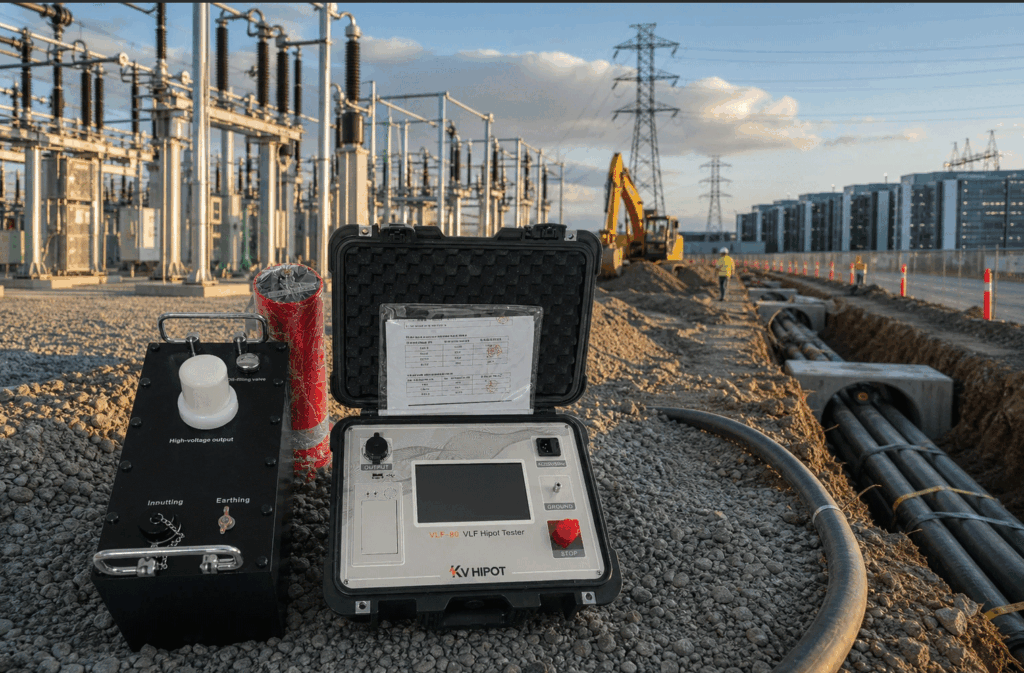
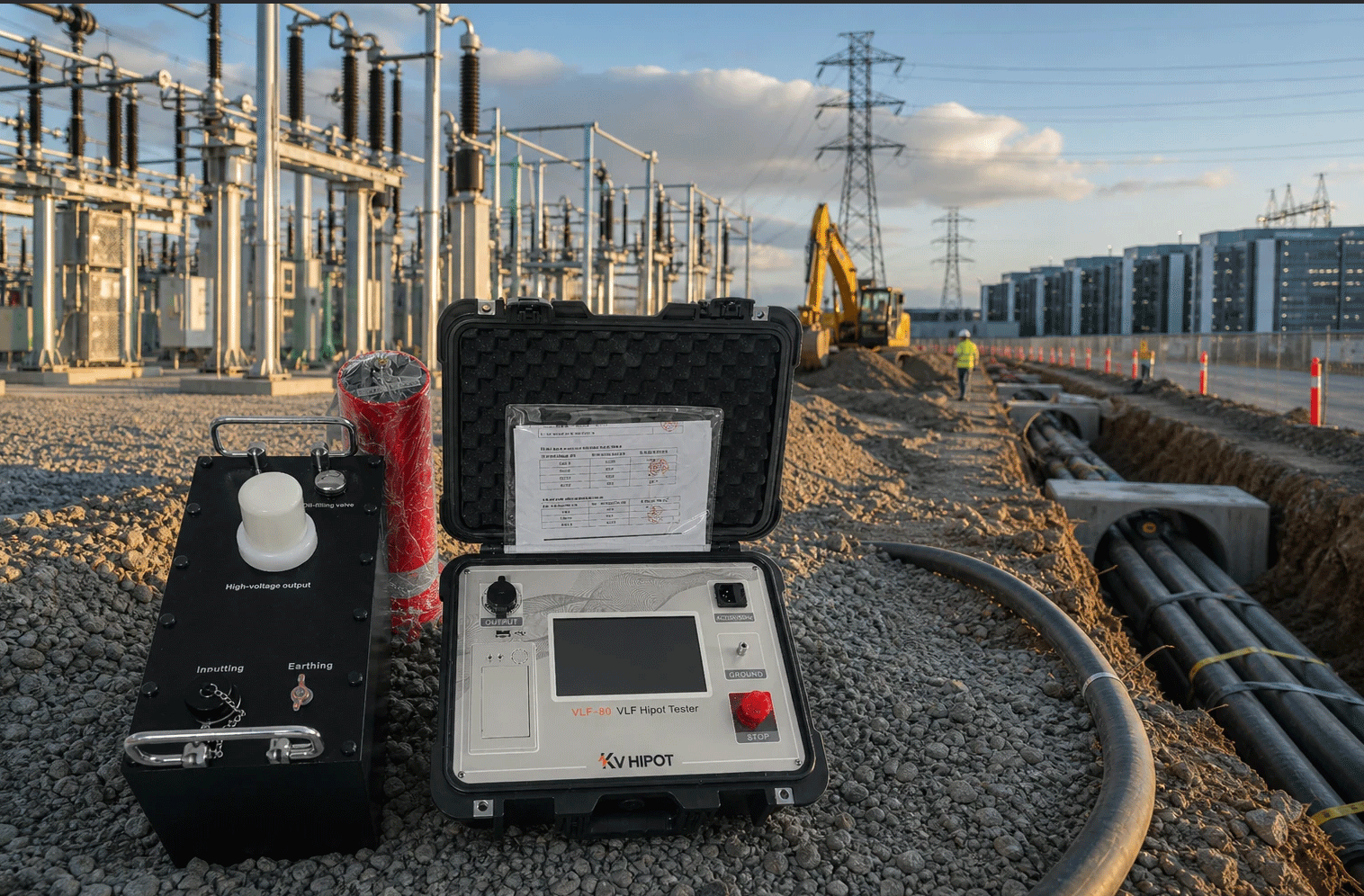
KV Hipot presents cable-testing and tan delta options in its VLF cable-testing overview. For the application above, use the VLF source product information to begin the equipment discussion, then identify the complete diagnostic configuration required. Source output ratings and loss-measurement capability are separate specifications. Provide the representative cable and operating conditions so the offered source, measuring function and accessories can be matched to the actual task.
Frequently Asked Questions
Is VLF the same as tan delta?
No. VLF describes excitation. Tan delta is a dielectric loss measurement requiring a suitable measurement chain. The measured quantity depends on the diagnostic function connected to the source, not simply on the presence of very low frequency voltage.
Does a withstand pass prove healthy insulation?
It establishes survival of the specified test. It does not exclude every defect or predict remaining service life. Future duty, installation condition and other failure mechanisms are not represented by survival of one applied stress.
Can tan delta locate a faulty joint?
Not directly. It evaluates overall loss behavior; localized concerns can require additional investigation using suitable methods. A location requirement needs an appropriate technique and measurement arrangement; overall loss alone does not encode distance.
Can insulation resistance replace specified diagnostics?
No. It measures a different response under DC conditions and cannot automatically satisfy an AC diagnostic requirement. A DC resistance observation cannot be converted directly into an AC loss or discharge assessment because the excitation and measured quantities differ.
What should happen when results disagree?
Check each test boundary and validity first, then consider the different physical questions. Preserve credible concerns rather than averaging unlike measurements. Check each measurement on its own terms and retain valid complementary findings rather than forcing them into one numerical score.


 English
 ไทย
 Tiếng Việt
 العربية
 Русский
 Italiano
 Español
 한국어
 Português do Brasil
 Français
 Español de México
 Português
 Türkçe
 Čeština
 Español de Argentina
 Slovenčina
 Dansk
 Polski
 Deutsch
 Ελληνικά
 O‘zbekcha
 Bahasa Indonesia
 Română