

High moisture in your switchgear causes catastrophic dielectric failures. Don’t risk expensive equipment damage and grid outages. An SF6 dew point meter ensures rapid, accurate moisture diagnostics and prevention.
An SF6 dew point meter is a specialized testing instrument used to measure the trace moisture content in sulfur hexafluoride gas. You need it because it acts as an early warning system, preventing moisture from forming highly corrosive acids during electrical arcing that can destroy internal switchgear components.
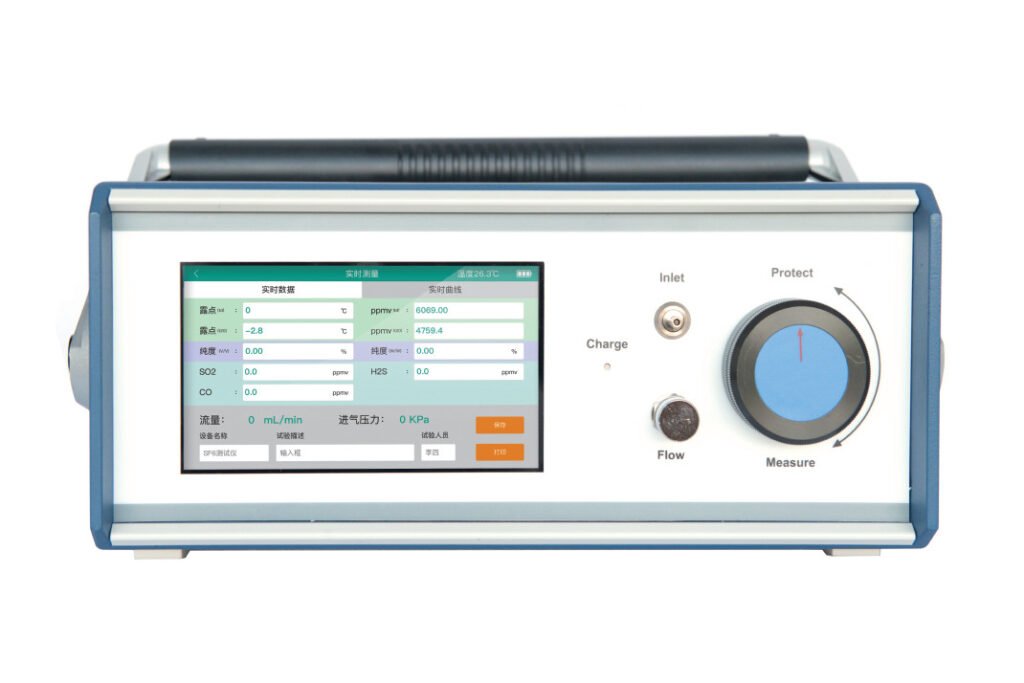
Understanding the fundamental role of this device is just the beginning. Let’s delve into the specific risks of moisture contamination and explore why investing in precision gas testing equipment is the smartest decision for your high-voltage maintenance strategy.
What does it mean if SF6 gas moisture content is too high?
Hidden moisture inside your high-voltage equipment is a ticking time bomb. If ignored, condensation leads to sudden flashovers and catastrophic equipment destruction. High moisture means your pristine insulating gas has become a dangerous, corrosive environment threatening your entire network.
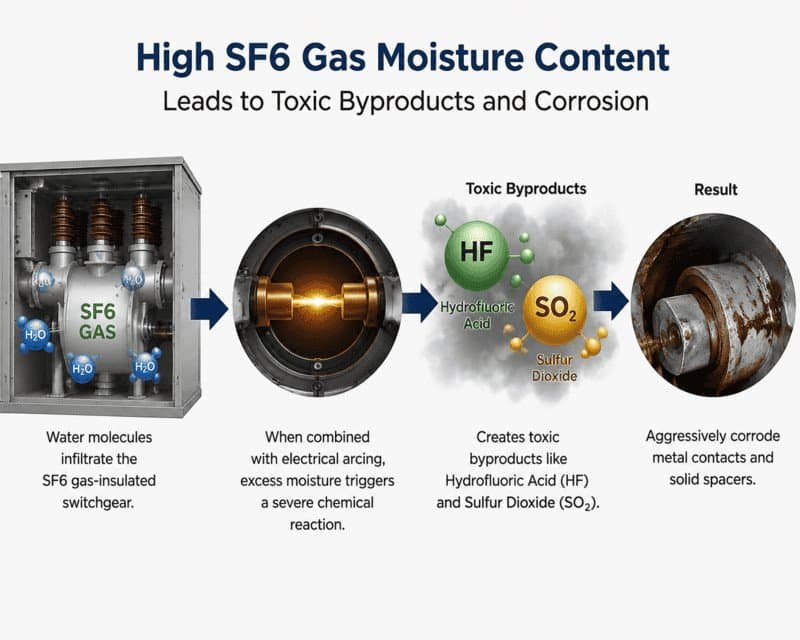
High SF6 gas moisture content means that water molecules have infiltrated the gas-insulated switchgear. When combined with electrical arcing, this excess moisture triggers a severe chemical reaction, creating toxic byproducts like Hydrofluoric Acid (HF) and Sulfur Dioxide (SO2) that aggressively corrode metal contacts and solid spacers.
The Chemical Threat Inside Your Switchgear
Pure Sulfur Hexafluoride (SF6) is incredibly stable and provides excellent arc-quenching capabilities. However, when moisture content is too high, the electrical energy from a normal circuit breaker arc breaks down the SF6 molecules. Instead of recombining back into stable SF6, the dissociated fluorine and sulfur atoms react with the intrusive water vapor ($H_2O$).
This volatile reaction produces highly toxic and corrosive byproducts. The most destructive among these are Hydrofluoric Acid (HF) and Sulfur Dioxide (SO2), which actively eat away at the internal architecture of your electrical equipment.
The Ripple Effect on Maintenance and Safety
For electrical engineers and substation maintenance teams, excessive moisture translates to skyrocketing maintenance costs and severe safety hazards. The acids attack internal components, leading to an irreversible degradation of the switchgear’s structural integrity.
| Defect Level | Moisture Level | Consequence of Arcing | Required Action |
|---|---|---|---|
| Normal | Low (<-36°C Dew Point) | SF6 gas recombines safely | Routine monitoring |
| Elevated | Medium (Approaching limit) | Minor byproduct formation | Schedule gas reclamation |
| Critical | High (>-15°C Dew Point) | Formation of HF and SO2 acids | Immediate equipment shutdown |
For independent testing agencies and EPC contractors, identifying these high-moisture scenarios early is critical. Relying on an advanced SF6 Gas Dew Point Tester like the KVLD series allows you to measure down to -80°C with ±2°C accuracy. By catching elevated moisture levels before arcing events occur, maintenance teams can successfully filter or replace the gas, saving hundreds of thousands of dollars in premature GIS replacement costs.
How does the dew point of SF6 gas affect insulation performance?
Diminished dielectric strength leads to unpredictable electrical shorts. A dropping insulation rating leaves your substation vulnerable to sudden arc flashes. The dew point directly controls the insulating capacity of SF6 gas, meaning poor moisture management inevitably compromises your high-voltage grid’s safety.
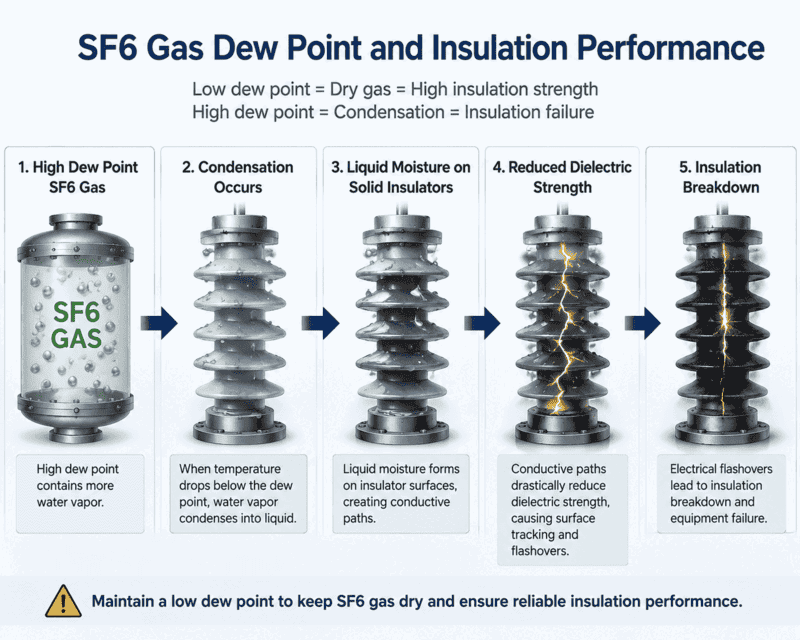
The dew point of SF6 gas affects insulation performance by determining when water vapor condenses into liquid inside the equipment. Liquid moisture on solid insulators creates conductive paths, drastically reducing the gas’s dielectric strength and causing surface tracking, electrical flashovers, and eventual insulation breakdown.
The Mechanics of Dielectric Degradation
In Gas-Insulated Switchgear (GIS) and high-voltage transformers, SF6 acts as an insulating blanket, preventing electrical currents from jumping between high-voltage conductors and the grounded enclosure. However, the physical state of water inside this environment is governed by the dew point temperature.
If the ambient temperature of the substation drops below the SF6 gas’s dew point, the trace water vapor transitions into liquid micro-droplets. These droplets settle on solid epoxy insulators and spacers. Since water is highly conductive, it creates a compromised path for high-voltage electricity to escape.
Surface Tracking and Flashover Risks
Once condensation forms, “surface tracking” begins. This is the phenomenon where electrical current continuously leaks across the surface of the wet insulator. Over time, this constant electrical stress burns carbonized tracks into the epoxy, permanently destroying its insulating properties until a massive, destructive flashover occurs.
| Moisture State | Dielectric Strength Impact | Mechanism of Failure |
|---|---|---|
| Vapor (Below Dew Point) | Negligible | Gas remains uniformly insulating. |
| Micro-Droplets (At Dew Point) | Severe Drop | Localized electrical stress and tracking. |
| Liquid Pool (Above Dew Point) | Total Failure | Direct conductive path causing instant flashover. |
For utility power plants operating in regions with massive temperature swings—such as the Middle East or high-altitude regions in South America—understanding the dew point is vital. High-quality testing equipment from KV HIPOT not only tracks the full-range curve of the dew point but also provides temperature conversion functions at 20°C, ensuring your insulation diagnostic data is standard-compliant regardless of local weather extremes.
What equipment detects SF6 moisture in switchgear?
Guessing the moisture level of your SF6 gas risks fatal equipment failure. Operating blind without precise diagnostics leaves your network exposed. Utilizing specialized micro-water testing equipment guarantees accurate moisture detection, giving you the confidence to approve safe substation operations.
SF6 moisture in switchgear is detected using an SF6 Gas Dew Point Tester. This specialized equipment, such as a micro-water moisture analyzer, uses advanced polymer capacitance or chilled mirror sensors to precisely measure trace moisture levels, often supporting automatic zero-point calibration and full-range curve tracking.
The Core Technology Behind Moisture Detection
To safeguard multimillion-dollar Gas-Insulated Switchgear (GIS), professionals rely on precision-engineered micro-water moisture analyzers. These devices are designed to handle pressurized SF6 gas and extract accurate trace moisture readings without exposing the sample to atmospheric humidity.
Modern SF6 dew point testers utilize highly sensitive electronic mass flow meters to regulate gas intake, typically between 0.5 to 0.9 L/min. By passing this controlled flow over advanced humidity sensors, the equipment translates complex chemical environments into a readable dew point value on a high-resolution touch screen.
Key Features of Professional SF6 Testing Equipment
When OEM manufacturers and third-party testing services select testing equipment, they look for robust functionality tailored for harsh substation environments.
| Equipment Feature | Technical Specification | Benefit for Field Engineers |
|---|---|---|
| Measurement Range | -80°C to +20°C (Supports ppmv) | Covers extremely dry to critical moisture levels. |
| Power Supply | Built-in high-capacity lithium battery | >8 hours of continuous field testing without AC power. |
| Data Management | 30–60 group data storage & PC output | Allows for easy auditing and compliance report generation. |
| Calibration | Zero-point automatic calibration | Eliminates sensor drift, ensuring excellent repeatability (±0.5°C). |
As a factory-direct supplier, KV HIPOT’s SF6 Gas Dew Point Tester (KVLD) exemplifies these capabilities. With its unique super-large storage function, excellent repeatability, and 5-meter standard Teflon measurement pipeline, the KVLD series is purposefully built for EPC contractors and utility maintenance teams who require reliable, simple operation during intensive field testing.
Why is SF6 moisture testing critical for GIS maintenance?
Neglecting GIS moisture checks leads to abrupt power grid collapses. Overlooking routine diagnostics results in extensive, unplanned outages and ruined equipment. Regular SF6 moisture testing serves as a vital preventative maintenance strategy, ensuring early detection of leaks and internal degradation before disaster strikes.
SF6 moisture testing is critical for GIS maintenance because it verifies the integrity of the gas insulation. Continuous testing prevents the formation of highly corrosive acids during arcing, stops solid insulator breakdown, guarantees compliance with IEC regulations, and ultimately extends the operational lifespan of expensive high-voltage electrical assets.
Shifting from Reactive to Preventative Maintenance
In the high-stakes world of power transmission and distribution, Gas-Insulated Switchgear (GIS) forms the backbone of the electrical grid. Why is moisture testing so pivotal? Because moisture is the primary catalyst for internal GIS degradation. By the time an external sign of failure occurs—like an unexpected trip or a catastrophic arc flash—the internal damage is usually irreversible.
Moisture testing shifts an organization’s maintenance strategy from reactive repairs to proactive asset management. By tracking the exact moisture trend over time, a maintenance manager can accurately predict when a gas compartment will require dehydration or complete SF6 replacement.
The ROI of Regular Moisture Diagnostics
For multinational EPC contractors and electrical engineering firms, the financial and regulatory implications of routine SF6 testing are massive.
| Consequence of Neglecting Testing | Benefit of Regular Moisture Testing |
|---|---|
| Catastrophic Equipment Loss | Maximizes GIS operational lifespan by decades. |
| Unplanned Substation Outages | Enables scheduled, cost-effective maintenance windows. |
| Regulatory Fines (IEC/IEEE) | Ensures auditable compliance with strict F-gas standards. |
| Exposure to Toxic Byproducts | Protects personnel by preventing HF/SO2 acid formation. |
Furthermore, testing provides definitive proof of quality during Factory Acceptance Tests (FAT) or post-installation commissioning. With testing equipment like the KV HIPOT KVLD, maintenance engineers can efficiently measure trace moisture and utilize the unique inquiry function to review past data records. This empowers service companies to provide precise, data-driven condition assessments, securing long-term service contracts and maximizing their profitability.
How is the dew point measured in sulfur hexafluoride?
Inaccurate gas sampling leads to dangerously flawed moisture readings. Using improper testing methods means you might pass dangerously wet equipment. Precisely measuring the dew point in SF6 requires isolated, pressurized sampling and advanced sensor technologies to capture true trace moisture levels accurately.
The dew point in sulfur hexafluoride is measured by connecting an SF6 dew point tester to the gas compartment via a sealed Teflon tube. A controlled flow of SF6 gas passes over an internal sensor, which analyzes the trace moisture and instantly calculates the dew point temperature with high precision.
The Step-by-Step Measurement Process
Measuring the dew point of highly pressurized SF6 gas in a live substation is a delicate procedure that requires precision engineering. The objective is to evaluate the gas without allowing ambient humidity to contaminate the sample.
First, the technician connects a high-quality measurement pipeline—typically an extended Teflon tube with a G1/4″ internal thread connection—to the switchgear’s gas sampling valve. Teflon is strictly used because it does not absorb or release moisture, ensuring the gas reaching the sensor remains pristine.
Internal Sensor Analysis
Once the valve is opened, the gas flows into the dew point tester. An electronic mass flow meter regulates the pressure and limits the gas flow (usually to 0.5~0.9 L/min). This guarantees the internal sensor is exposed to a steady, readable volume of gas.
| Measurement Phase | Equipment Action | Purpose |
|---|---|---|
| Purging | Clearing the Teflon tube | Removes residual ambient air and moisture from the connection line. |
| Flow Regulation | Mass flow meter activates | Stabilizes the SF6 gas flow to 0.5 – 0.9 L/min for optimal sensor contact. |
| Sensor Analysis | Zero-point automatic calibration | Tracks the full-range curve and detects water vapor concentration. |
| Calculation | Microprocessor processes data | Converts the raw moisture data into a highly accurate Dew Point (°C) or ppmv reading. |
Modern instruments provide excellent repeatability (±0.5°C) and fast response speeds. By converting the sensor’s electrical changes into digital data, the microprocessor instantly displays the results on a high-resolution touch screen. This advanced methodology guarantees that testing service providers and OEM engineers get the reliable, laboratory-grade measurements necessary for safe power grid operations.
What is the difference between SF6 dew point and moisture content (ppmv)?
Confusing dew point with ppmv creates severe diagnostic errors in the field. Misinterpreting these parameters can lead to failing perfectly good gas or accepting hazardous moisture levels. Understanding the precise difference between these two measurements ensures strict adherence to IEC safety standards and flawless maintenance reporting.
SF6 dew point is the specific temperature at which water vapor condenses into liquid within the gas, measured in Celsius. Moisture content (ppmv), or parts per million by volume, represents the absolute ratio of water molecules to SF6 gas molecules, regardless of the surrounding environmental temperature or gas pressure.
Understanding the Two Measurement Metrics
For electrical contractors and heavy industry maintenance managers, understanding the terminology of SF6 gas testing is crucial. Both dew point and ppmv measure moisture, but they represent the data in fundamentally different ways.
Dew Point (°C): This is a dynamic, temperature-based value. It tells an engineer exactly how cold the equipment must get before the invisible water vapor turns into dangerous, conductive liquid water. It is a highly practical metric because it relates directly to the ambient operating conditions of the substation.
Moisture Content (ppmv): This is an absolute volumetric measurement. If you have 1 million molecules of gas, ppmv tells you exactly how many of those are water molecules. It is a static number that does not change with temperature fluctuations, making it ideal for laboratory analysis and long-term condition monitoring.
Converting Between Dew Point and ppmv
Many international standards (like IEC and IEEE) utilize both metrics, making it necessary for field teams to switch between the two.
| Metric | Unit | What it Represents | Best Use Case |
|---|---|---|---|
| Dew Point | °C or °F | Condensation threshold | Field risk assessment, predicting flashovers |
| Moisture Content | ppmv / ppmw | Absolute water concentration | Chemical analysis, gas reclamation planning |
Fortunately, modern SF6 Gas Dew Point Testers simplify this process. Advanced units, such as the KVLD series, support an automatic dew point conversion function. The high-resolution display can toggle seamlessly between a -80~+20°C dew point reading and its exact ppmv equivalent. This dual-display capability is highly favored by third-party calibration labs and EPC contractors, allowing them to provide comprehensive, easily understood test reports to diverse global clients.
الخاتمة
Effectively managing SF6 moisture is non-negotiable for the safety and longevity of gas-insulated switchgear. An SF6 dew point meter serves as a critical early warning system, accurately measuring trace moisture to prevent the formation of highly toxic acids during arcing. By understanding the differences between dew point and ppmv, and utilizing advanced testers with automatic calibration and high-resolution tracking, maintenance teams can confidently prevent catastrophic dielectric failures. For EPC contractors and utility managers, investing in professional SF6 testing equipment ensures operational compliance, reduces unexpected outages, and ultimately safeguards your entire high-voltage power network.

 English
  ไทย
ไทย  Tiếng Việt
  العربية
  Русский
  Italiano
  Español
  한국어
한국어  Português do Brasil
  Français
  Español de México
  Português
  Türkçe
  Čeština
  Español de Argentina
  Slovenčina
  Dansk
Dansk  Polski
  Deutsch
  Ελληνικά
  O‘zbekcha
  Bahasa Indonesia
  Română